
Abstract
Background
Consensus is lacking regarding the relative safety and oncological outcomes of minimally invasive compared to abdominal hysterectomy.
Objectives
To estimate complications and survival rates of minimally invasive hysterectomy (MIH) (i.e., laparoscopic or robotic assisted) compared to total abdominal hysterectomy (TAH) for endometrial and cervical cancer.
Methods
A systematic quantitative review of randomised controlled trials (RCTs) comparing MIH with TAH for the treatment of endometrial or cervical cancer. Medline-PubMed, Cochrane Library, Scopus, ongoing clinical trials and the grey literature were searched until December 1, 2024.
Main Outcome Measures
Complications, overall survival (OS), disease-free survival (DFS), and disease-specific survival (DSS) rates.
Results
Twenty-nine RCTs enrolling 6,127 patients were included. The risk of bladder injury was higher in the MIH group [risk ratio (RR): 1.84, 95% confidence interval: (CI): 1.03-3.29, I2: 0%), as was the risk of vaginal injury (RR: 12.39, 95% CI: 1.61-95.29, P=0.02, I2: 0%) but the risk of wound dehiscence was lower (RR: 0.32, 95% CI: 0.13-0.83, P=0.02, I2: 13%) compared to abdominal hysterectomy. Among cervical cancer patients, the risk for blood transfusion was significantly lower with the MIH (RR: 0.42, 95% CI: 0.21-0.84, P=0.01, I2: 0%). Among endometrial cancer patients, the OS, DFS, and DSS were comparable between routes of hysterectomy. In contrast, the overall the OS and DFS rates were lower for minimally invasive compared to abdominal hysterectomy (0.94, 95% CI: 0.90-0.98, P=0.005, I2:0 %) and (0.89, 95% CI: 0.84-0.94, P<0.001, I2: 0%) respectively.
Conclusions
Bladder and vaginal injuries are higher with minimally invasive compared to abdominal hysterectomy. Survival rates for endometrial cancer are comparable but for cervical cancer, minimally invasive hysterectomy is associated with poorer survival outcomes and this should be taken into account when counselling patients and deciding upon the route of hysterectomy.
What is New?
TAH has superior survival outcomes compared to minimally invasive hysterectomy.
Keywords: Cancer, laparoscopy, hysterectomy, minimally invasive surgery, postoperative complications, intraoperative complications, survival analysis
Introduction
Endometrial and cervical cancers are the most frequent gynaecological malignancies, together accounting for the majority of cancer cases affecting the female reproductive tract. Endometrial cancer constitutes the most frequently observed malignant gynaecologic disease and the fourth most frequent cancer type in high-income countries, with an incidence of 11.1 per 100,000 women,- and cervical cancer constitutes the fourth cause of cancer-associated deaths among the female population globally., The incidence of uterine malignancies is expected to increase by 2040. Age, smoking, dietary habits, and medical conditions such as hypertension and diabetes are associated with increased endometrial cancer risk. Higher oestrogen levels observed in situations such as late-onset menopause and obesity constitute risk factors for endometrial cancer development., Cervical cancer is mainly linked to human papillomavirus (HPV) infection,, with oncogenic types 16 and 18 being associated with about 70% of the cases. Other factors related to cervical cancer development are smoking, higher parity, history of sexually transmitted diseases, and long-term contraceptive use. Since vaccination against HPV was implemented, however, the incidence of cervical cancer has declined in high-income countries, and most cases and deaths are observed in low- and middle-income countries.
The typical surgical management of endometrial cancer includes total hysterectomy with bilateral salpingo-oophorectomy (BSO) and lymphadenectomy, including sentinel node biopsy to assess lymph node involvement and define disease stage., , - The role of bilateral pelvic and para-aortic lymphadenectomy remains controversial, and some authors suggest that these procedures should only be performed in high-risk patients. Ovaries may be preserved for select younger patients with low-grade tumours wishing to maintain reproductive capability, but those women need to be meticulously monitored and concomitantly treated with hormonal therapy. The typical surgical management of early-stage cervical cancer [International Federation of Gynaecology and Obstetrics (FIGO) stages IB1, IB2, and IIA1] includes type C radical hysterectomy and pelvic lymphadenectomy with/without para-aortic lymphadenectomy., , FIGO stage IA1 is usually managed with cervical conisation or simple extra-fascial hysterectomy. In the case of lymph vascular invasion, type B modified radical hysterectomy and pelvic lymphadenectomy must be considered. FIGO stage IA2 is typically managed with type B modified radical hysterectomy and pelvic lymphadenectomy., - Adjuvant or neoadjuvant treatment (chemotherapy, radiotherapy, and hormonal therapy) depends on disease stage and is crucial for managing the cancer, complementing the primary surgical treatment., , , , , ,
Since the laparoscopic hysterectomy was introduced by Reich et al. and the first report of laparoscopic restaging in endometrial cancer was published by Childers et al., the surgical management of gynaecologic malignancies has evolved significantly; minimally invasive surgery (MIS) techniques, namely, total laparoscopic hysterectomy (TLH), laparoscopically assisted vaginal hysterectomy (LAVH), or robot-assisted laparoscopic hysterectomy (RALH)/total robotic hysterectomy (TRH), are being used more and more in gynaecologic cancers., , , , , , Surgical management differs substantially between endometrial and cervical cancer. In presumed uterus-confined endometrial cancer, total hysterectomy with BSO and staging by a MIS approach is currently the preferred surgical strategy. By contrast, in early-stage cervical cancer requiring radical hysterectomy, open surgery remains the standard approach after the LACC trial demonstrated inferior disease-free survival (DFS) and overall survival (OS) with minimally invasive radical hysterectomy. Current guidance allows minimally invasive radical surgery, if at all, only in carefully selected low-risk tumours and in highly specialised high-volume centres after comprehensive counselling.-
In any case, the surgical approach should be individualized according to the patient’s characteristics, comorbidities, and intraoperative findings., , , , , , , Total abdominal hysterectomy (TAH) constitutes a widely practiced approach that provides good visual access, haptic feedback, and tactile sensation. The latter is significant in malignant diseases, where removing the entire tumour is of existential importance. The intraoperative spread of cancer cells is less common in TAH. Thus, TAH provides more predictable surgical and oncologic results., , , , However, TAH is associated with higher morbidity, higher postoperative complications rates such as wound infections, haemorrhage, transfusion, bowel perforation, and venous thromboembolic events, prolonged recovery time and hospitalisation, and higher postoperative pain due to the incision size, impacting quality of life postoperatively., , , , By using MIS manoeuvrability and precision are enhanced and these techniques are associated with lower morbidity, reduced blood loss and surgical trauma, reduced infection rates, shorter recovery time and hospitalisation, and less postoperative pain. Thus, MIS is a suitable approach for high-risk patients, namely, obese and older people. However, MIS may not be feasible in patients presenting with anatomical challenges (uterine size, adhesions), which require longer operation times and greater surgical expertise, and is linked to increased risk of intraoperative injuries (due to limited visualisation) and potential tumour dissemination., , , , , , , Recent evidence suggests, moreover, that MIS reliability in terms of oncologic outcomes is debatable, particularly in the case of early-stage cervical cancer., , Therefore, in the case of cervical cancer, TAH continues to be the standard approach as the long-term cancer results of MIS need to be more extensively evaluated., In the case of endometrial cancer, TAH seems to be neither superior nor inferior to MIS when considering OS and DFS rates.,
Several recent systematic reviews and meta-analyses (SRMAs) aimed to compare MIS and TAH.- The SRMAs enrolling cervical cancer patients included observational studies. Of these, one SRMA included 21 observational and only one randomised controlled trial (RCT). Of the SRMAs enrolling endometrial cancer patients,- three included only observational studies, and one SRMA included nine RCTs. However, since then, more studies have been published. No reliable conclusions have been drawn yet, however, particularly regarding oncologic outcomes, and thus there is a need to summarise the findings exclusively from randomised studies, given that the level of evidence of RCTs is higher. We therefore conducted a systematic review and meta-analysis restricted to RCTs to provide a higher-level synthesis of surgical, complication, recurrence, and survival outcomes in endometrial and cervical cancer, with disease-specific interpretation of the findings.
Methods
The Preferred Reporting Items for Systematic Reviews and Meta-Analyses (PRISMA) statement was considered during the conduction of this SRMA. This SRMA conforms to the PRISMA checklist.
A protocol for the present review was prepared a priori and discussed among the coauthors, including members of the ESGE Special Interest Group on Education and Training. However, it was not prospectively registered in PROSPERO or another public registry.
Inclusion and Exclusion Criteria
Prospective RCTs were included that had enrolled patients with endometrial or/and cervical cancer who were treated with total hysterectomy. The intervention arm included those who received MIS, namely, either TLH, or LAVH, or RALH/TRH, and the comparator arm included those women in whom TAH or a different type of MIS (different from the intervention arm) was performed. No limitations regarding BSO or pelvic or para-aortic lymphadenectomy were applied. The outcomes of interest were operative time, intraoperative blood loss, haemoglobulin reduction, hospitalisation duration, total number of patients with at least one complication, total number of complications (events), intraoperative and postoperative complications (events), blood transfusion rates, cancer recurrence rates at the end of follow-up, death rates (total and cancer-related) at the end of follow-up, and OS, DFS, and disease-specific survival (DSS). We excluded studies that exclusively assessed pain scores and pain management, pelvic floor function, and quality of life (for detailed criteria, see ).
Search Strategy and Sources
The search strategy was formulated based on the Peer Review of Electronic Search Strategies checklist using free text and medical subject heading terms. Search terms were “gynaecology”, “obstetrics”, “laparoscopy”, and “laparoscopic hysterectomy” with synonyms and alternatives (for the search queries, see ). We intentionally used an open, highly sensitive search strategy without filters to capture all potentially eligible studies, while final specificity was ensured during title/abstract and full-text screening according to the predefined inclusion criteria. The following databases were searched: Medline-PubMed, Scopus, Cochrane Library, ClinicalTrials.gov, openGrey, and EU Clinical Trials Register. The PROSPERO database was searched for ongoing SRMAs. Abstracts of congresses and meetings of gynaecological-obstetric and endoscopic surgery societies were also investigated. Our last search was conducted on 1 December 2024.
Study Selection and Data Extraction
After carrying out pilot-calibration procedures, the reviewers separately completed the study selection and data extraction, with another reviewer resolving any disagreements that arose. If there were questions about the eligibility of a study, we tried to communicate with the authors of the paper via email. Zotero 7.0.11 was used as the reference manager software. We used predefined collection forms recommended by the Cochrane Collaboration for Intervention Reviews for data extraction. Data were extracted based on a predefined list of variables and outcomes ().
Definitions
Surgical procedures were defined based on the textbook Williams Gynaecology, 3rd edition (MIS, TLH,, LAVH, RALH/TRH,TAH, BSO,, and pelvic/para-aortic lymphadenectomy)., “Minimally invasive hysterectomy (MIH)” was used by this SRMA during the quantitative synthesis instead of MIS, embracing TLH, or LAVH, or RALH/TRH. Operative time was defined as the time after anaesthesia, including patient and surgery preparation and the procedure time from the first incision to closure. Intraoperative blood loss was defined as the total volume of suctioned blood minus the volume of fluids used for irrigation during surgery. Haemoglobulin reduction was defined as the difference between the preoperative value and the value recorded within 2 days postoperatively. Hospitalisation duration was the hospital stay after the surgery until discharge.
Complications were divided into intraoperative (occurring from the start of anaesthesia until the end) and postoperative (arising from the end of anaesthesia until 6 months after surgery). Blood transfusion was defined as the transfusion of at least one Red blood cells unit divided into intraoperative and postoperative transfusion. The outcome of “Intraoperative injuries” was a compound one, including bladder, vaginal, bowel, nerve, vascular, ureteral, urethral, and visceral injuries. Postoperative complications included: ileus (inhibition of gastrointestinal propulsion without signs of mechanical obstruction for more than 48 h), wound complications, vaginal vault/cuff complications, urinary symptoms, haematoma (at any site and of any duration), fever (≥38 °C), postoperative infection (of any type), fistulas, and deep vein thrombosis/pulmonary embolism (DVT/PE)., “Wound complications” were a compound outcome, including wound dehiscence and wound infection. “Vaginal vault/cuff complications” were a compound outcome, including vault haematoma, bleeding, infection, dehiscence/laceration, and leakage. “Urinary symptoms” were a compound outcome, including urinary incontinence, ureterostenosis, urinary retention, and urinary tract infection (UTI). “Fistulas” were a compound outcome, including ureterovaginal, vesicovaginal, rectovaginal, and gastrointestinal fistulas.
Definitions of recurrence rates and death (total and cancer-related) were considered self-explanatory. OS, DFS, and DSS were defined based on the National Cancer Institute of the US government.- OS was defined as the time from randomisation until the date of death from any cause. DFS was defined as the time from randomisation to disease recurrence or death from cancer. DSS was defined as the time from randomisation to death because of cancer.
Risk-of-Bias Assessment
We used the RoB 2 Cochrane Tool for RCTs to assess the risk of bias of the initially included studies. We excluded studies with an overall “High” risk from the review and the synthesis. Figures visualising the risk of bias were created with the Robvis tool. Two reviewers conducted bias assessment separately, while a third reviewer settled disagreements.
Quantitative Synthesis
The quantitative synthesis was conducted using RevMan Web 8.14.0 and R-Studio 2024.12.0 software, and the relevant forest plots were created. The treatment effect was measured using mean and standard deviation (SD) with a 95% confidence interval (CI) for numerical variables, and the standardised mean difference (SMD) was calculated. When only the median, interquartile range, and/or range were reported, data were converted to an estimated mean and SD based on statistical methods described elsewhere. The treatment effect was measured using risk ratio (RR) with a 95% CI for categorical variables. The Mantel-Haenszel method was applied for categorical data and the inverse variance method for numerical data. When a study contained a zero cell in one arm, the standard continuity correction implemented in RevMan was applied by adding 0.5 to all four cells of the corresponding 2 x 2 table. Studies with zero events in both arms did not contribute to RR estimation because the relative effect was undefined. In the case of OS, DFS, and DSS, the effect was measured using the rate ratio and hazard ratio (HR) with a 95% CI after making the necessary logarithmic calculations using statistical software. For survival outcomes, HRs were directly extracted when these were reported in the original studies. HRs were not reconstructed from Kaplan-Meier curves or other published summary data. When studies reported survival rates rather than HRs, rate ratios were used as the effect measure. Because these effect measures reflect different statistical approaches, HR-based and rate ratio-based analyses were performed separately. For OS outcomes, HRs were interpreted as measures of the hazard of death over time. For DFS outcomes, HRs were interpreted as measures of the hazard of recurrence or death over time. Therefore, an HR greater than 1 indicates a higher hazard of the corresponding adverse event in the MIS group compared with TAH.
Statistical heterogeneity was assessed using the Higgins I2 test and chi-squared Cochran Q-test (α: 0.1). If I2 ≥75%, quantitative synthesis was not feasible. The fixed-effects model was used if I2 <50%, while the random-effects model was used if I2 ≥50% (or chi-squared Cochran Q-test P<0.1).
Sensitivity analysis was applied in the case of persistent statistical heterogeneity by removing those studies creating it. Subgroup analysis was conducted based on cancer type and surgery type. Further stratification simultaneously by cancer type and specific MIS subtype was not consistently feasible because these data were not uniformly reported in the included studies and because of the small numbers available for individual subgroups. When data were missing, we contacted the authors of the paper. No imputation was necessary.
Publication bias was assessed only when ≥10 studies per outcome were available for analysis. Funnel plots were designed by RevMan Web 8.14.0, while Egger’s and rank correlation tests were conducted with R-Studio 2024.12.0.
Evidence Quality
Two reviewers independently assessed the quality of evidence for each outcome, and a third reviewer resolved any disagreements. The assessment aligned with the Grading of Recommendations Assessment Development and Evaluation (GRADE) system and was conducted by using the GRADEpro GDT web application.
Results
Study Selection
summarises the study selection process. After removing duplicate records, 6228 were deemed potentially appropriate, and 5728 studies were removed by screening the titles and abstracts. Five studies were ongoing trials (). The 500 remaining studies, plus 11 new studies found through a reference check, were full-text assessed. The full-text assessment yielded 45 studies to potentially be included. Of these, 14 were excluded- (for the reasons for excluding each study, see and ). Thus, 31 studies were included before the risk-of-bias assessment. Two of these 31 studies were judged as “High Risk” (see below) and, therefore, excluded.,
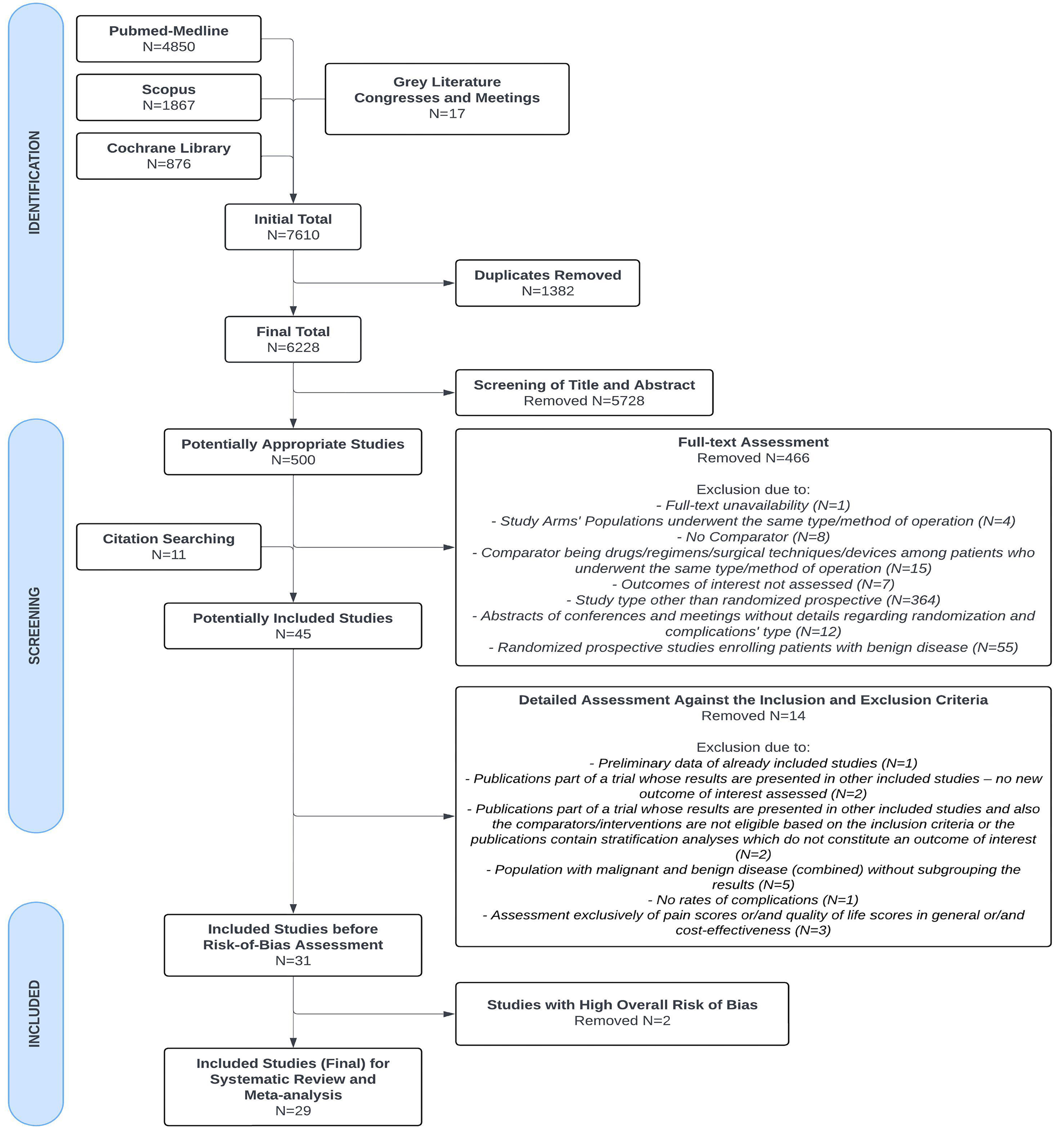
Study Characteristics
Twenty-nine studies were included in this SRMA, enrolling 6,127 patients., , , , - summarises the study designs and settings, inclusion and exclusion criteria, numbers of participants, interventions, comparators, and primary outcomes.
We included 15 single-center studies,-,,-,,,,-,, two-center studies,, and 12 multi-center studies., , , , , , , , , , , Eighteen studies included only women with endometrial cancer, , - and ten studies included only those with cervical cancer,, , - while one study included patients with three types of malignancies (either endometrial, cervical, or ovarian). Patient characteristics are given in the “Synthesis” section.
TLH was the intervention in 17 studies,,,-,-, LAVH in six studies,-,,, RALH in one study, while MIH (either TLH, or LAVH, or RALH/TRH) was performed in six studies., , , , , In all included studies, patients underwent BSO., , , , - Pelvic,,,,-,,-,- and para-aortic, , lymphadenectomy was carried out for all patients in 20 and three studies, respectively. In four studies, pelvic lymphadenectomy,-, and in ten studies, para-aortic lymphadenectomy ,,,,-,, depended on the cancer stage (not carried out for all patients). In all studies, the comparator was TAH, except for four studies: two studies compared TLH with RALH (one regarding endometrial cancer and another regarding cervical cancer), one study regarding endometrial cancer compared LAVH with TLH and, finally, one study regarding cervical cancer compared LAVH with TRH. Regarding our outcomes of interest, total operative time was assessed by 19 studies,,,,,,,,,,,-,-, intraoperative blood loss/haemoglobulin reduction by 16 studies,,,,,,,,,,,,,,-, intraoperative and postoperative complications by 21 studies,,,-,,,,,-,- total hospitalisation duration by 18 studies,,,,,,,,-,,,,- OS by 11 studies,, , , , , , , , , , DFS by 10 studies,, , , , , , , , , DSS by three studies,, , death rate by 14 studies,,,,-,,,,,,- recurrence rate by 15 studies,, , , , , , , , , , , , - and recurrence sites/metastases by 11 studies., , , , , , , , , ,
The following articles concerned the same clinical trials but they reported different outcomes of interest: i) Zullo et al. and Zullo et al. (with precisely the same number of participants), ii) Janda et al., Obermair et al., and Janda et al. (with different participant numbers reported), iii) Mourits et al., Bijen et al., and Reijntjes et al. (Mourits et al. and Bijen et al. have precisely the same number of participants, while Reijntjes et al. included fewer participants), iv) Walker et al. and Walker et al. (with different participant numbers reported), v) Campos et al. and Campos et al. (with precisely the same number of participants), and vi) Ramirez et al., Ramirez et al., and Obermair et al. (Ramirez et al. and Ramirez et al. have the same number of participants, while Obermair et al.included fewer participants).
Risk-of-Bias Assessment
We used the RoB 2 Cochrane Tool for randomised trials to assess the risk of bias of the initially included studies.As stated previously, studies with an overall “High” risk of bias were ultimately excluded. The results per outcome are presented in . depicts the relevant traffic light plots, and shows the relevant summary plots. Two studies were excluded because they were judged to be at overall high-risk of bias, in both cases primarily due to concerns in Domain 1 (bias arising from the randomisation process), as the reports stated that randomisation had been performed but did not provide sufficient methodological details regarding sequence generation and/or allocation concealment.
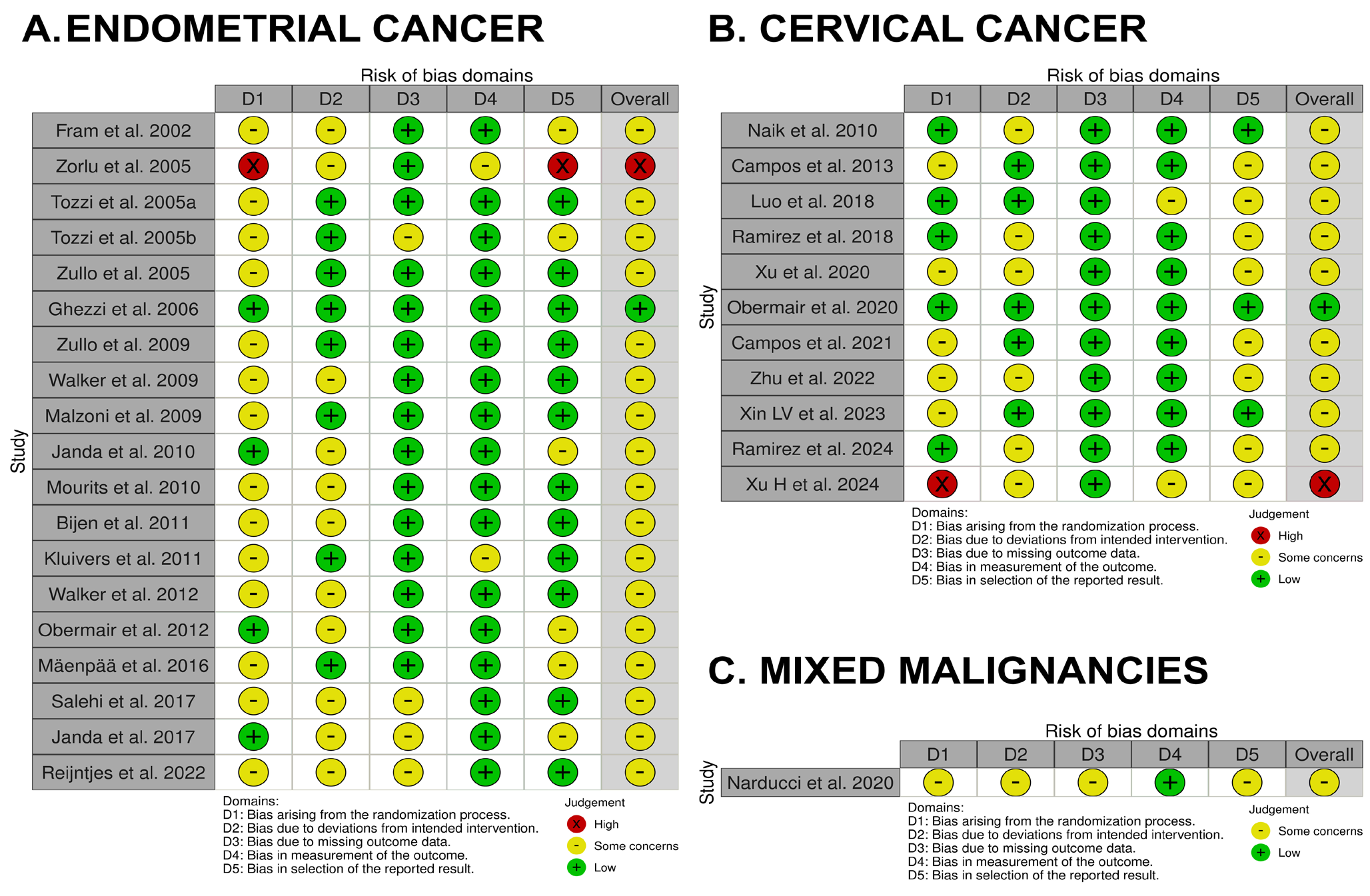
Synthesis
Population Characteristics
The included studies enrolled a total of 6,127 patients; 3,972 were treated by MIS, and among them, 3,006 had endometrial, 597 cervical, and 369 either endometrial or cervical or ovarian cancer (practically speaking, the latter subgroup only concerns one study). The rest of the 2,155 women received TAH, and among them, 1,628 had endometrial and 527 had cervical cancer.
There were no significant differences between the two groups (MIS vs. TAH) regarding age, body mass index, parity, tumour FIGO stage, tumour grade, and histopathologic type. However, among the cervical cancer subgroup, women in whom TAH was performed had significantly higher parity than those who underwent MIS. The mean follow-up time in the whole population was 47.5±9.6 months.
Most tumours in both groups were of FIGO stage I (79.8% in the MIS group and 81.5% in the TAH group) and of grade I (39.3% and 33.9%, respectively) and II (34.9% and 38.2%, respectively). Among patients with endometrial cancer, the most common histopathologic type was endometrioid carcinoma in both groups. Among patients with cervical cancer, the most common histopathologic type was squamous carcinoma in both groups.
In most patients MIH was performed (59.9%), referring to the minimally invasive technique. However, MIH (MIS) is a broader term, often used by several studies as a compound intervention, which includes TLH, LAVH, and RALH/TRH together, making it impossible to clarify how many patients received what type of MIH. If we exclude MIH, TLH was the most common technique used in the studies included (28.2%).
summarises the aforementioned and further details about the population characteristics per group and cancer-type subgroups.
Table 1. Patient characteristics per group and cancer-type subgroups. Note that numerical variables are presented as weighted mean ± weighted standard deviation based on the relevant values of the included studies.
- | Minimally invasive surgery (TLH, LAVH, RALH/TRH) | Open surgery (TAH) | |||||||
|---|---|---|---|---|---|---|---|---|---|
- | Endometrial (n=3006) | Cervical (n=597) | Mixed (n=369) | All (n=3972) | Endometrial (n=1628) | Cervical (n=527) | All (n=2155) | ||
Age (years) | 63.3±1.04 | 47.5±5.9 | 57.3±10.6 | 60.3±6.2 | 63.0±0.8 | 45.4±1.7 | 58.6±7.7 | ||
BMI (kg/m2) | 30.4±2.9 | 29.1±2 | 30.5±0.1 | 30.1±2.8 | 31.1±3.2 | 26.1±0.3 | 30.3±3.5 | ||
Parity | 2.5±0.6 | 2.4±0.2 | - | 2.5±0.5 | 2.2±0.1 | 2.9±0.8 | 2.5±0.6 | ||
Surgical stage | FIGO stage I | 2057/2635 (78.1%) | 528/597 (88.4%) | 289/369 (78.3%) | 2874/3601 (79.8%) | 1232/1561 (78.9%) | 469/527 (89%) | 1701/2088 (81.5%) | |
FIGO stage II | 175/2635 (6.6%) | 69/597 (11.6%) | 56/369 (15.2%) | 300/3601 (8.4%) | 123/1561 (7.9%) | 55/527 (10.4%) | 178/2088 (8.5%) | ||
FIGO stage III | 295/2635 (11.2%) | 0/597 (0%) | 12/369 (3.3%) | 307/3601 (8.5%) | 162/1561 (10.4%) | 527 (0%) | 162/2088 (7.8%) | ||
FIGO stage IV | 6/2635 (0.2%) | 0/597 (0%) | 2/369 (0.5%) | 8/3601 (0.2%) | 5/1561 (0.3%) | 0/527(0%) | 5/2088 (0.2%) | ||
Unspecified | 102/2635 (3.9%) | 0/597 (0%) | 10/369 (2.7%) | 112/3601 (3.1%) | 39/1561 (2.5%) | 3/527 (0.6%) | 42/2088 (2%) | ||
Grade | Grade I | 495/978 (50.6%) | 48/402 (12%) | - | 543/1380 (39.3%) | 310/644 (48.1%) | 42/393 (10.7%) | 352/1037 (33.9%) | |
Grade II | 315/978 (32.2%) | 167/402 (41.6%) | - | 482/1380 (34.9%) | 232/644 (36%) | 164/393 (41.7%) | 396/1037 (38.2%) | ||
Grade III | 119/978 (12.2%) | 104/402 (25.9%) | - | 223/1380 (16.2%) | 90/644 (14%) | 106/393 (27%) | 196/1037 (18.9%) | ||
Unspecified | 49/978 (5%) | 83/402 (20.5%) | - | 132/1380 (9.6%) | 12/644 (1.9%) | 81/393 (20.6%) | 93/1037 (9%) | ||
Histopathology | Endometrioid | 2083/2536 (82%) | 0/496 (0%) | 166/369 (45%) | 2249/3401 (66.1%) | 1312/1562 (84%) | 0/427 (0%) | 1312/1989 (65.9%) | |
Mucinous | 12/2536 (0.5%) | 0/496 (0%) | 4/369 (1.1%) | 16/3401 (0.5%) | 5/1562 (0.3%) | 0/427 (0%) | 5/1989 (0.25%) | ||
Serous | 241/2536 (9.5%) | 0/496 (0%) | 13/369 (3.5%) | 254/3401 (7.5%) | 138/1562 (8.8%) | 0/427 (0%) | 138/1989 (6.9%) | ||
Clear-cell | 38/2536 (1.5%) | 0/496 (0%) | 10/369 (2.7%) | 48/3401 (1.4%) | 23/1562 (1.5%) | 0/427 (0%) | 23/1989 (1.2%) | ||
Mixed-cell | 55/2536 (2.2%) | 4/496 (0.8%) | 0/369 (0%) | 59/3401 (1.7%) | 30/1562 (1.9%) | 5/427 (1.2%) | 35/1989 (1.8%) | ||
Squamous | 4/2536 (0.2%) | 343/496 (69.2%) | 114/369 (30.9%) | 461/3401 (13.6%) | 4/1562 (0.3%) | 298/427 (69.8%) | 302/1989 (15.2%) | ||
Small-cell | 2/2536 (0.08%) | 0/496 (0%) | 0/369 (0%) | 2/3401 (0.1%) | 1/1562 (0.06%) | 0/427 (0%) | 1/1989 (0.05%) | ||
Adenocarcinoma | 1/2536 (0.04%) | 106/496 (21.4%) | 18/369 (4.9%) | 125/3401 (3.7%) | 5/1562 (0.3%) | 99/427 (23.2%) | 104/1989 (5.2%) | ||
Neuroendocrinoid | 0/2536 (0%) | 3/496 (0.6%) | 0/369 (0%) | 3/3401 (0.1%) | 0/1562 (0%) | 0/427 (0%) | 0/1989 (0%) | ||
Adenoid | 0/2536 (0%) | 18/496 (3.6%) | 0/369 (0%) | 18/3401 (0.5%) | 0/1562 (0%) | 0/427 (0%) | 0/1989 (0%) | ||
Sarcoma | 65/2536 (2.58%) | 0/496 (0%) | 3/369 (0.8%) | 68/3401 (2%) | 37/1562 (2.4%) | 0/427 (0%) | 37/1989 (1.9%) | ||
Others | 35/2536 (1.4%) | 22/496 (4.4%) | 41/369 (11.1%) | 98/3401 (2.8%) | 7/1562 (0.44%) | 25/427 (5.8%) | 32/1989 (1.6%) | ||
Type of surgery | TLH | 810 (26.9%) | 117 (19.6%) | 193 (52.3%) | 1120 (28.2%) | NA | NA | NA | |
LAVH | 129 (4.3%) | 37 (6.2%) | 0 (0%) | 166 (4.2%) | NA | NA | NA | ||
MIH | 1969 (65.5%) | 413 (69.2%) | 0 (0%) | 2382 (59.9%) | NA | NA | NA | ||
RALH | 98 (3.3%) | 0 (0%) | 176 (47.7%) | 274 (6.9%) | NA | NA | NA | ||
TRH | 0 (0%) | 30 (5%) | 0 (0%) | 30 (0.8%) | NA | NA | NA | ||
Total population | |||||||||
- | Patients with endometrial cancer | Patients with cervical cancer | Patients either with endometrial or cervical or ovarian cancer | All enrolled patients | |||||
Mean total follow-up (months) | 51.5±6.9 | 37.9±7.2 | 32.3±13.2 | 47.5±9.6 | |||||
TLH: Total laparoscopic hysterectomy, LAVH: Laparoscopically assisted vaginal hysterectomy, RALH: Robot-assisted laparoscopic hysterectomy, TRH: Total robotic hysterectomy, TAH: Total abdominal hysterectomy, BMI: Body mass index, FIGO: International Federation of Gynaecology and Obstetrics, NA: Not applicable.
Operation Time, Intraoperative Blood Loss, Haemoglobulin Reduction, and Hospitalisation Duration
Regarding studies comparing MIS and TAH, after sensitivity analysis, the mean operative time was significantly lower in the TAH group for all cancer-type and surgery subgroups and in the whole population (SMD: 0.69, 95% CI: 0.50 to 0.88, P<0.001, I2: 68%, ).
Before and after sensitivity analysis, the mean intraoperative blood loss was significantly lower in the MIS group among all cancer-type subgroups and TLH, MIH, and RALH/TRH subgroups. For the whole population SMD was -0.98 (95% CI: -1.29 to -0.66, P<0.001, I2: 71%, favouring MIS, ). Haemoglobulin reduction (all studies concerned endometrial cancer and TLH) was significantly lower in the MIS group, but the result presented high statistical heterogeneity.
Before and after sensitivity analysis, the mean hospital stay was significantly shorter in the MIS group for TLH, LAVH, RALH/TRH, and all cancer-type subgroups. The latter was significant for the whole population but presented high statistical heterogeneity ().
Complications
The risk of a patient presenting at least one complication did not differ between MIS and TAH for surgery subgroups, cancer-type subgroups, and the whole population. The total complication rates were lower in the MIS group among LAVH (23/63 in MIS vs. 58/59 in TAH, RR 0.37, 95% CI 0.27 to 0.52, P<0.001) and endometrial cancer subgroup (580/2359 in MIS vs. 418/1438 in TAH, RR 0.84, 95% CI 0.73 to 0.96, P=0.01, I2: 17%). The overall effect for the rest of the surgery, cancer-type subgroups, and the whole population was not significant ().
Intraoperative Complications and Injuries
No differences were found regarding the risk of intraoperative complications (number of events) among the surgery, cancer-type subgroups, and the whole population. The risk of intraoperative injuries was significantly higher in the MIS group among the entire population (241/3142 in MIS vs. 102/2141 in TAH, RR 1.53, 95% CI 1.23 to 1.91, P<0.001, I2: 0%) and among all cancer-type and TLH and MIH subgroups. Still, it was not significant in the LAVH subgroup ( and ).
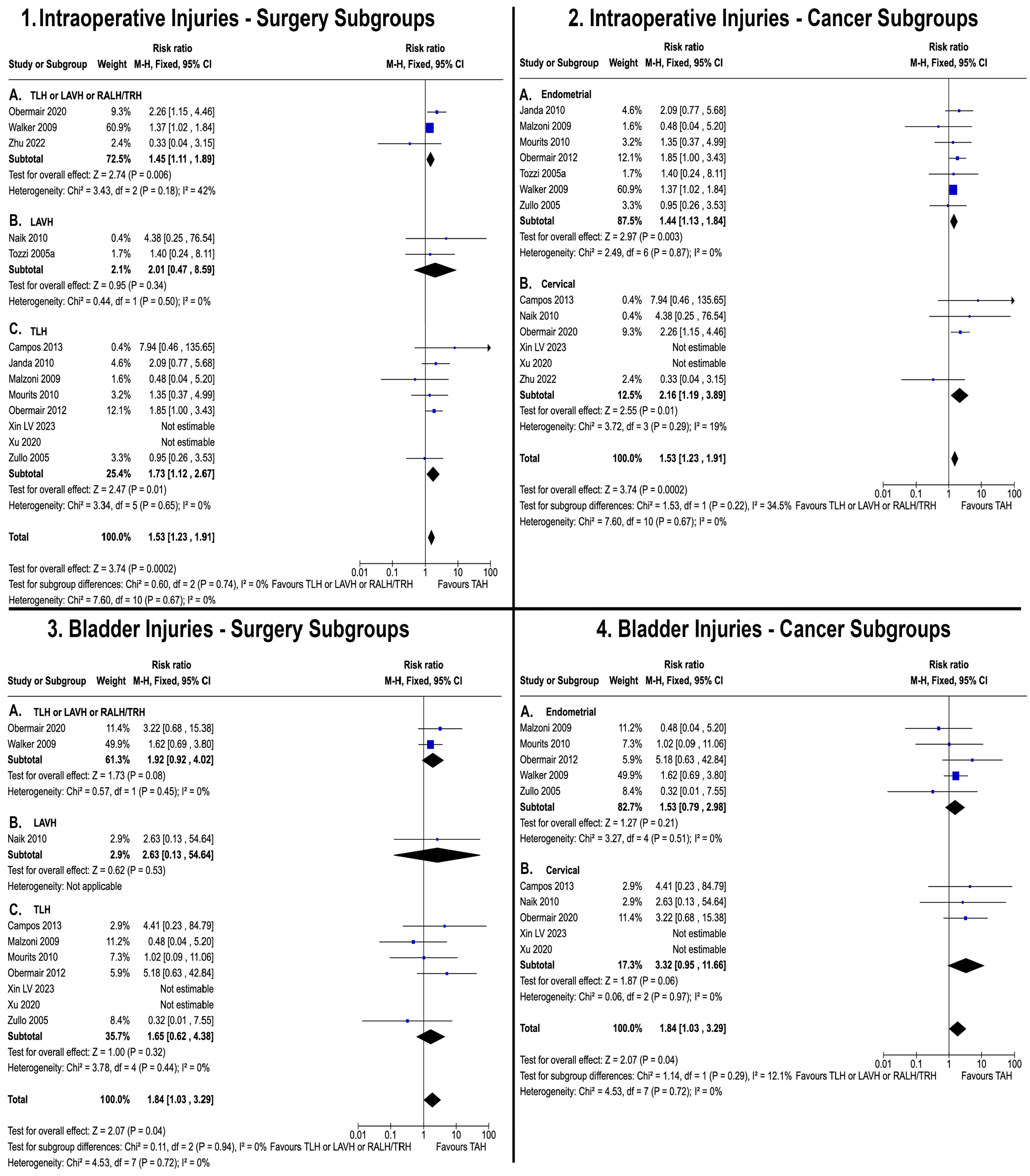
The risk for bladder injury was significantly higher in the MIS group for the whole population (40/2795 in MIS vs. 14/1846 in TAH, RR 1.84, 95% CI 1.03 to 3.29, I2: 0%), but not significant for any of the cancer-type and surgery subgroups ( and ).
The risk for vaginal injury was significantly higher in the MIS group for the whole population (RR: 12.39, 95% CI 1.61 to 95.29, P=0.02, I2: 0%) and in patients who underwent TLH (RR: 21.6, 95% CI 1.28 to 363.58, P=0.03, I2: 0%, ). However, this estimate was based on a rare outcome, with 13/467 events in the MIS group vs. 0/408 in the TAH group across two RCTs.
The risks for bowel, nerve, vascular, ureteral, urethral, and visceral injuries and uterus rupture did not differ between the groups in the whole population or subgroup analyses.
Blood Transfusion Rates
The risk for blood transfusion (intra- and postoperatively) was significantly lower in the MIS (4/92) vs. the TAH (14/91) for the LAVH subgroup (RR: 0.28, 95% CI 0.10 to 0.82, P=0.02, I2: 0%). It was also significantly lower in the MIS (11/296) vs. the TAH (25/274) for the cervical cancer subgroup (RR: 0.42, 95% CI 0.21 to 0.84, P=0.01, I2: 0%) (). However, this estimate was based on a rare outcome. The risk of transfusion did not differ between the groups for the whole population and the rest of the subgroups. Intraoperative and postoperative blood transfusion rates were assessed in one study, and no significant difference was noted.
Postoperative Complications
The risk of postoperative complications was lower in the MIS for the TLH subgroup (19/73 in MIS vs. 32/69 in TAH, RR: 0.57, 95% CI 0.36 to 0.90, P=0.02, I2: 0%), LAVH subgroup (20/63 in MIS vs. 49/59 in TAH, RR: 0.38, 95% CI 0.26 to 0.56, P<0.001), and endometrial cancer subgroup (31/103 in MIS vs. 67/97 in TAH, RR: 0.44, 95% CI 0.30 to 0.65, P<0.001, I2: 24%). However, the result was not significant among the entire population, MIH, and cervical cancer subgroups ().
The risk for ileus development was significantly lower in the MIS group for the whole population (69/2249 in MIS vs. 73/1357 in TAH, RR: 0.52, 95% CI 0.38 to 0.72, P<0.001, I2: 0%) and for MIH and endometrial cancer subgroups ().
The risk for wound complications was significantly lower in the MIS group regarding the whole population (74/2948 in MIS vs. 98/2000 in TAH, RR: 0.42, 95% CI 0.23 to 0.76, P=0.004, I2: 42%), the TLH, and the endometrial and cervical cancer subgroups (). Wound dehiscence risk was significantly lower in the MIS group for the whole population (4/559 in MIS vs. 12/411 in TAH, RR: 0.32, 95% CI 0.13 to 0.83, P=0.02, I2: 13%) and the TLH subgroup. These studies enrolled only women with endometrial cancer (). The results for wound infection risk were analogous: risk was significantly lower in the MIS group for the whole population (64/2559 in MIS vs. 60/1621 in TAH, RR: 0.65, 95% CI 0.46 to 0.92, P=0.02, I2: 19%) and TLH and endometrial cancer subgroups ().
Risk of vaginal vault/cuff complications was higher in the MIS group regarding the MIH subgroup (11/279 in MIS vs. 2/257 in TAH, RR: 5.07, 95% CI 1.13 to 22.64, P=0.03). Still, conclusions cannot be drawn since only one study assessed this outcome among patients in the MIH subgroup. The latter risk did not significantly differ between the two groups regarding the whole population and the rest of the subgroups ().
The risk for developing urinary symptoms (compound outcome including urinary incontinence, urinary retention, UTI, and uterostenosis) did not significantly differ between the two arms regarding the whole population and all subgroups. Particularly, the risk for UTI and urinary retention did not differ between MIS and TAH among the entire population, surgery type, and cancer-type subgroups. The risk for haematoma development (compound outcome), fever development, postoperative infection, fistulas, and DVT/PE did not differ between the two groups overall and for any subgroup.
Recurrence and Death Rates-Survival
After sensitivity analysis, the risks for total and 4.5/5-year recurrence were significantly higher in the MIS group regarding the cervical cancer subgroup (40/352 in MIS vs. 12/343 in TAH, RR: 3.23, 95% CI 1.73 to 6.04, P<0.001, I2: 0%). Regarding the MIH subgroup, the latter results presented high statistical heterogeneity even after the sensitivity analysis. No significant differences were noted among the whole population and the rest of the subgroups ( and ).
The risk for local recurrence was significantly higher in the MIS group among the cervical cancer and MIH subgroups (18/319 in MIS vs. 4/312 in TAH, RR: 4.40, 95% CI 1.51 to 12.86, P=0.007, ). The risk for recurrence at multiple sites was significantly higher in the MIS group only among the cervical cancer subgroup (10/319 in MIS vs. 2/312 in TAH, RR: 4.89, 95% CI 1.08 to 22.14, P=0.04, ). The risk for vaginal vault/cuff, pelvic, wound/port-site recurrence, and distant metastasis did not significantly differ between the two groups in the whole population and for any subgroup.
The risk for death by the disease (cancer) was significantly higher in the MIS group for the cervical cancer subgroup after sensitivity analysis (18/352 in MIS vs. 3/343 in TAH, RR: 5.69, 95% CI 1.72 to 18.84, P=0.004, I2: 0%, ). The risk of death (general) did not significantly differ for the whole population and the subgroups. The MIH subgroup results presented high statistical heterogeneity even after sensitivity analysis.
Cervical cancer patients in whom TAH was performed presented significantly higher OS and DFS rate ratios and decreased OS and DFS HR than those of the MIS group. The cervical cancer OS rate ratio was 0.94 (95% CI 0.90 to 0.98, P=0.005, I2: 0%), and the relevant OS-HR was 2.55 (95% CI 1.35 to 4.85, P=0.004, I2: 0%). The cervical cancer DFS rate ratio was 0.89 (95% CI 0.84 to 0.94, P<0.001, I2: 0%), and the relevant DFS HR was 3.61 (95% CI 1.95 to 6.69, P<0.001, I2: 0%). The OS and DFS rate ratios and OS and DFS HRs for the whole population and among endometrial cancer patients did not reach statistical significance ( and ).
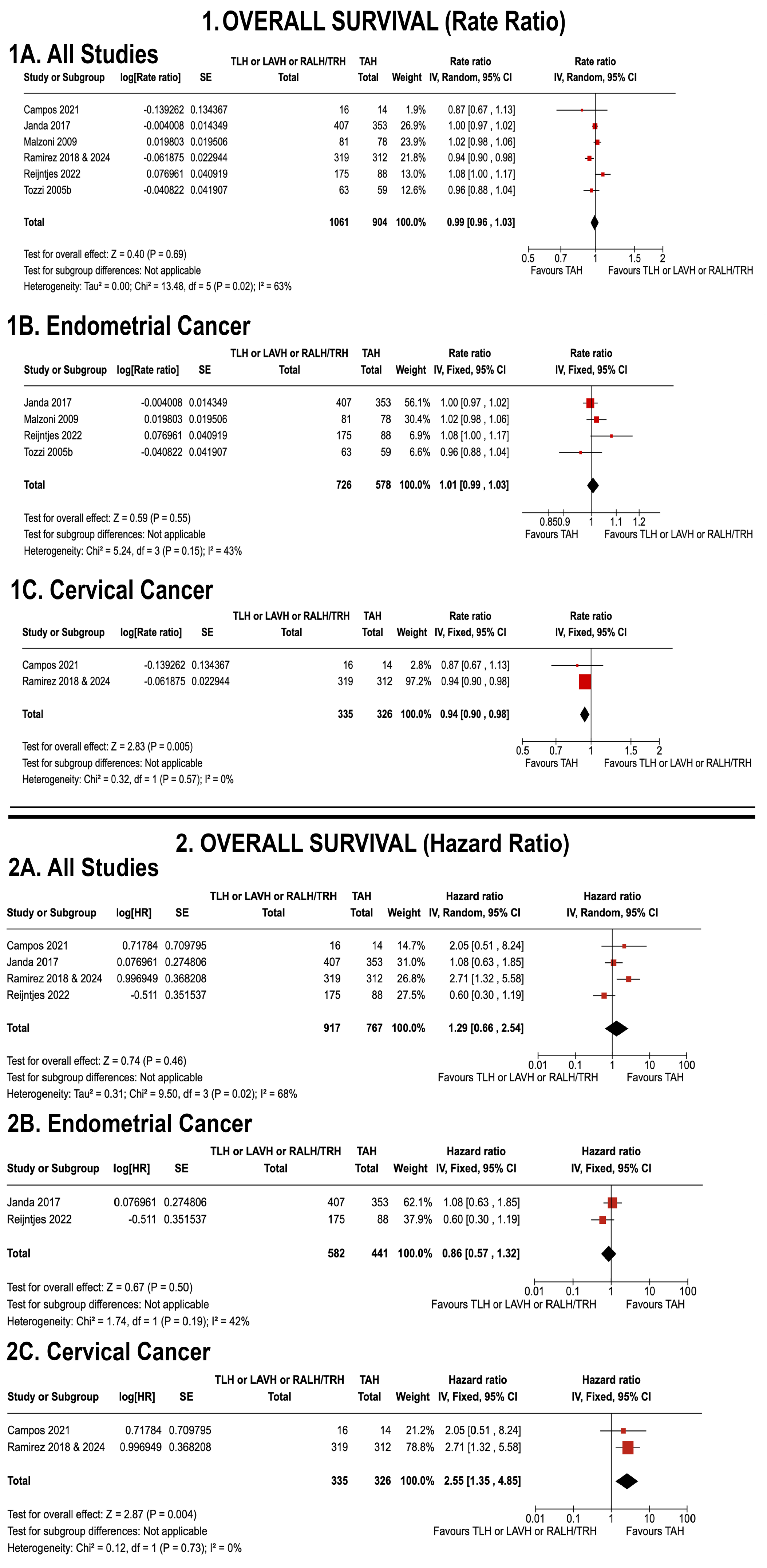
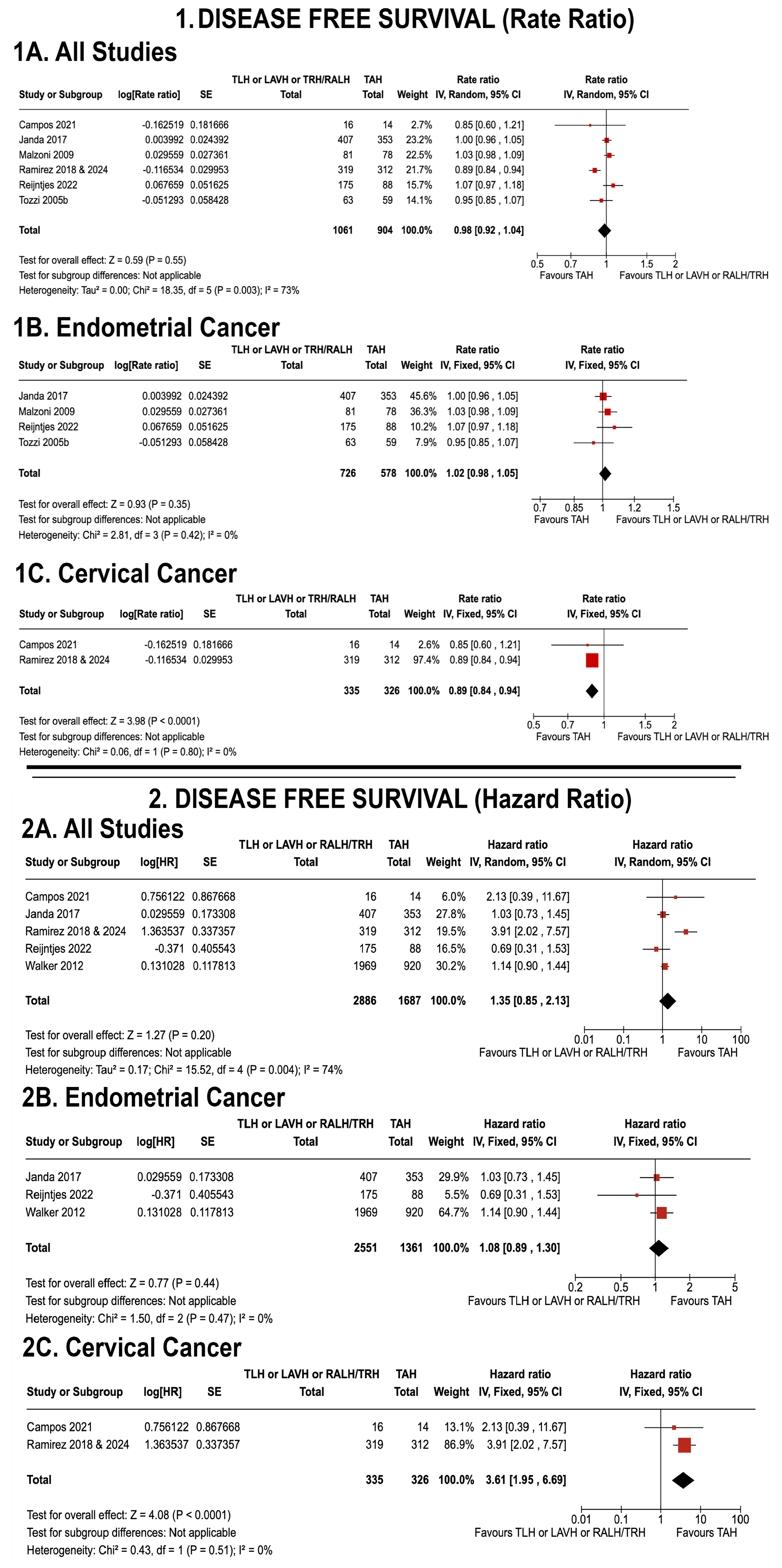
TLH: Total laparoscopic hysterectomy, LAVH: Laparoscopically assisted vaginal hysterectomy, RALH/TRH: Robot-assisted laparoscopic hysterectomy/total robotic hysterectomy, TAH: Total abdominal hysterectomy, MIS: Minimally invasive surgery, DFS: Disease-free survival, SE: standard error, CI: Confidence interval, IV: Inverse variance.
DSS rate ratio was assessed by two studies enrolling patients with endometrial cancer,, and no significant overall effect was noted (rate ratio 1.03, 95% CI 0.96 to 1.11, P=0.42, I2: 43%). DSS-HR was assessed by two studies (one enrolling patients with endometrial and the other patients with cervical cancer), and no significant overall effect was noted (HR: 1.32, 95% CI 0.32 to 5.45, P=0.70, I2: 80%). However, the latter result is characterised by high statistical heterogeneity, and no reliable conclusions can be drawn ().
Studies Comparing Outcomes Between Different Minimally Invasive Techniques
Regarding studies comparing TLH and RALH, the SMD was not significant concerning operative time and intraoperative blood loss, but reliable conclusions cannot be drawn due to the high heterogeneity. Haemoglobulin reduction and hospitalisation duration did not differ.
The risk of a patient presenting at least one complication did not differ between the groups. Similarly, the risk for total, intraoperative, and postoperative complications (number of events) and intraoperative injuries did not differ across the groups. The risk for blood transfusion, infection, fistulas, wound complications, and DVT/PE did not differ between the groups. Similarly, the risk for intraoperative and postoperative blood transfusion, fever, and vaginal vault/cuff complications did not differ, but these outcomes were only assessed by one study. The risk for UTI and urine retention did not differ between the two groups, but it was only evaluated by one study. The risk for developing urinary symptoms was significantly lower in the RALH group than TLH (RR: 2.99, 95% CI 1.12 to 8.04, P=0.03, I2: 0%).
Death rates, OS, and DFS were assessed by one study, and no significant differences were noted.
The study comparing TLH and LAVH revealed a significantly longer operative time in the LAVH subgroup. Still, no other significant differences were noted regarding intraoperative blood loss, hospitalisation duration, total number of patients with at least one complication, total complications (number of events), intraoperative complications and injuries, postoperative complications, blood transfusion, recurrence rates, and recurrence sites.
The study comparing LAVH and TRH revealed a significantly shorter hospitalisation duration and fewer total postoperative complications (compound outcome–number of events) in the TRH group. No other differences were noted regarding the rest of the outcomes of interest of this SRMA. Similarly, no differences were recorded regarding recurrence, cancer-related death, and overall death rates.
Publication Bias
Ten or more studies were available for analysis for the following outcomes: operative time, intraoperative blood loss, hospitalisation duration, intraoperative injuries, bladder injuries, blood transfusion, wound complications, recurrence, and death by cancer. Based on the funnel plots, Egger’s test (mixed-effects meta-regression and weighted regression), and rank correlation test, publication bias was detected for the following: operative time, intraoperative blood loss, hospitalisation duration, wound complications, recurrence, and death by cancer (). Publication bias was not detected for intraoperative injuries, bladder injuries, and blood transfusion ().
Strength of Evidence GRADE Reporting System
For each outcome of interest, we took under consideration the number of studies, the design, the inconsistency in results across the studies, the directness/indirectness and the precision/imprecision of the reported results, the publication bias probability, the effect size, the plausible confounding influence, and the dose-response gradient. shows the results of the above evaluation.
Table 2. Summary of findings for the included studies after evaluation with GRADE reporting system.
Outcomes | No. of participants (studies) | Certainty of the evidence (GRADE) | Relative effect (95% CI) | Study event rates (%) | Anticipated absolute effects | NNH/NNTB (95% CI) | ||
|---|---|---|---|---|---|---|---|---|
With total abdominal hysterectomy | With minimally invasive surgery (MIS) | Risk with total abdominal hysterectomy | Risk difference with minimally invasive surgery | |||||
Operative time (minutes) | 2149 (10) | High | - | 984 | 1165 | - | SMD 0.69 SD more (0.5 more to 0.88 more) | NA |
Intraoperative blood loss (mL) | 1053 (7) | High | - | 466 | 587 | - | SMD 0.98 SD fewer (1.29 fewer to 0.66 fewer) | NA |
Hospitalisation duration (days)-cancer subgroups | 3105 (5) | High | - | 1120 | 1985 | - | SMD 1.3 SD fewer (1.84 fewer to 0.75 fewer) | NA |
Hospitalisation duration (days)-surgery subgroups | 3880 (8) | High | - | 1548 | 2332 | - | SMD 1.99 SD lower (2.73 lower to 1.24 lower) | NA |
Total number of complications (intra- and postoperative -number of events)-cancer subgroups | 4397 (8) | Low | RR 0.88 (0.74 to 1.06) | 582/1726 (33.7%) | 778/2671 (29.1%) | 337 per 1.000 | 40 fewer per 1.000 (88 fewer to 20 more) | NNTB 22 (14-56) |
Total number of complications (intra- and postoperative -number of events)-surgery subgroups | 4519 (1) | Moderate | RR 0.77 (0.60 to 0.99) | 640/1785 (35.9%) | 801/2734 (29.3%) | 359 per 1.000 | 82 fewer per 1.000 (143 fewer to 4 fewer) | NNTB 16 (11-27) |
Intraoperative injuries | 5283 (13) | Moderate | RR 1.53 (1.23 to 1.91) | 102/2141 (4.8%) | 241/3142 (7.7%) | 48 per 1.000 | 25 more per 1.000 (11 more to 43 more) | NNH 35 (24-64) |
Bladder injury | 4641 (10) | High | RR 1.84 (1.03 to 3.29) | 14/1846 (0.8%) | 40/2795 (1.4%) | 8 per 1.000 | 6 more per 1.000 (0 fewer to 17 more) | NNH 149 (79-2688) |
Vaginal injury | 875 (2) | High | RR 12.39 (1.61 to 95.29) | 0/408 (0.0%) | 13/467 (2.8%) | 0 per 1.000 | 0 fewer per 1.000 (0 fewer to 0 fewer) | NNH 36 (22-77) |
Blood transfusion (intra- and postoperative) | 4709 (10) | High | RR 0.60 (0.34 to 1.07) | 113/1881 (6.0%) | 167/2828 (5.9%) | 60 per 1.000 | 24 fewer per 1.000 (40 fewer to 4 more) | NNTB 979 (CI crosses null) |
Total number of postoperative complications (number of events) | 800 (5) | Moderate | RR 0.61 (0.33 to 1.12) | 205/385 (53.2%) | 191/415 (46.0%) | 532 per 1.000 | 208 fewer per 1.000 (357 fewer to 64 more) | NNTB 14 (8-344) |
Wound complications | 4948 (11) | High | RR 0.42 (0.23 to 0.76) | 98/2000 (4.9%) | 74/2948 (2.5%) | 49 per 1.000 | 28 fewer per 1.000 (38 fewer to 12 fewer) | NNTB 42 (29-76) |
Wound dehiscence | 970 (5) | High | RR 0.32 (0.13 to 0.83) | 12/411 (2.9%) | 4/559 (0.7%) | 29 per 1.000 | 20 fewer per 1.000 (25 fewer to 5 fewer) | NNTB 46 (23-186) |
Wound infection | 4180 (9) | Moderate | RR 0.65 (0.46 to 0.92) | 60/1621 (3.7%) | 64/2559 (2.5%) | 37 per 1.000 | 13 fewer per 1.000 (20 fewer to 3 fewer) | NNTB 84 (43-720) |
Vaginal vault/cuff complications | 1806 (8) | Low | RR 1.98 (0.66 to 5.94) | 23/861 (2.7%) | 48/945 (5.1%) | 27 per 1.000 | 26 more per 1.000 (9 fewer to 132 more) | NNH 42 (24-163) |
Total recurrence-cancer subgroups | 4710 (10) | Low | RR 1.21 (0.86 to 1.69) | 173/1885 (9.2%) | 324/2825 (11.5%) | 92 per 1.000 | 19 more per 1.000 (13 fewer to 63 more) | NNH 44 (25-198) |
Total recurrence-surgery subgroups | 4267 (10) | Moderate | RR 1.01 (0.82 to 1.25) | 177/1667 (10.6%) | 294/2600 (11.3%) | 106 per 1.000 | 1 more per 1.000 (19 fewer to 27 more) | NNH 145 (CI crosses null) |
4.5/5-year recurrence-cancer subgroups | 4287 (8) | High | RR 1.48 (1.02 to 2.15) | 148/1718 (8.6%) | 300/2569 (11.7%) | 86 per 1.000 | 41 more per 1.000 (2 more to 99 more) | NNH 33 (21-83) |
4.5/5-year recurrence-surgery subgroups | 4688 (8) | High | RR 1.11 (0.92 to 1.34) | 152/2344 (6.5%) | 270/2344 (11.5%) | 65 per 1.000 | 7 more per 1.000 (5 fewer to 22 more) | NNH 20 (15-30) |
Local recurrence | 1175 (4) | Very low | RR 1.26 (0.38 to 4.25) | 18/537 (3.4%) | 32/638 (5.0%) | 34 per 1.000 | 9 more per 1.000 (21 fewer to 109 more) | NNH 61 (CI crosses null) |
Recurrence in multiple sites | 4270 (4) | Low | RR 1.25 (0.43 to 3.67) | 26/1673 (1.6%) | 49/2597 (1.9%) | 16 per 1.000 | 4 more per 1.000 (9 fewer to 41 more) | NNH 301 (CI crosses null) |
Death by cancer-cancer subgroups | 4710 (10) | Moderate | RR 1.19 (0.95 to 1.48) | 111/1885 (5.9%) | 213/2825 (7.5%) | 59 per 1.000 | 11 more per 1.000 (3 fewer to 28 more) | NNH 61 (33-568) |
Death by cancer-surgery subgroups | 4267 (10) | Low | RR 1.06 (0.84 to 1.32) | 118/1667 (7.1%) | 203/2600 (7.8%) | 71 per 1.000 | 4 more per 1.000 (11 fewer to 23 more) | NNH 138 (CI crosses null) |
Overall survival (hazard ratio)-endometrial cancer | 661 (2) | High | HR 0.86 (0.57 to 1.32) | 326 participants | 335 participants | 209 per 1.000 | 26 fewer per 1.000 (84 fewer to 57 more) | NA |
Overall survival-cervical cancer | 661 (2) | High | Rate ratio 0.94 (0.90 to 0.98) | 326 participants | 335 participants | 945 per 1.000 | 57 fewer per 1.000 (94 fewer to 19 fewer) | NA |
Overall survival (hazard ratio)-cervical cancer | 661 (2) | High | HR 2.55 (1.35 to 4.85) | 326 participants | 335 participants | 56 per 1.000 | 81 more per 1.000 (19 more to 188 more) | NA |
Disease-free survival-endometrial cancer | 1306 (4) | High | Rate ratio 1.02 (0.98 to 1.05) | 578 participants | 728 participants | 905 per 1.000 | 18 more per 1.000 (18 fewer to 45 more) | NA |
Disease-free survival (hazard ratio)-endometrial cancer | 3912 (3) | High | HR 1.08 (0.89 to 1.30) | 1,361 participants | 2551 participants | 103 per 1.000 | 8 more per 1.000 (11 fewer to 29 more) | NA |
Disease-free survival-cervical cancer | 661 (2) | High | Rate ratio 0.89 (0.84 to 0.94) | 326 participants | 335 participants | 963 per 1.000 | 106 fewer per 1.000 (154 fewer to 58 fewer) | NA |
Disease-free survival (hazard ratio)-cervical cancer | 661 (2) | High | HR 3.61 (1.95 to 6.69) | 326 participants | 335 participants | 37 per 1.000 | 90 more per 1.000 (34 more to 186 more) | NA |
Disease-specific survival | 385 (2) | High | Rate ratio 1.03 (0.96 to 1.11) | 147 participants | 238 participants | 918 per 1.000 | 28 more per 1.000 (37 fewer to 101 more) | NA |
Disease-specific survival (hazard ratio) | 894 (2) | Moderate | HR 1.32 (0.32 to 5.45) | 400 participants | 494 participants | 28 per 1.000 | 9 more per 1.000 (19 fewer to 115 more) | NA |
Abbreviations. CI: Confidence interval, HR: hazard ratio, RR: risk ratio, SMD: standardised mean difference; NNH: Number needed to harm, NNTB: Number needed to treat for benefit.
Notes:
The risk in the intervention group (and its 95% confidence interval) is based on the assumed risk in the comparison group and the relative effect of the intervention (and its 95% CI).
NNH/NNTB: The values were approximated from the crude study event rates using the absolute risk difference (MIS minus TAH) with 95% CI. NNH is shown when MIS increased event risk. NNTB is shown when MIS reduced event risk. "CI crosses null" indicates that the risk-difference 95% CI included 0, so a bounded NNH/NNTB CI was not estimable. NA indicates that NNH/NNTB was not applicable to quantitative, rate-ratio, or hazard-ratio outcomes.
High certainty: We are very confident that the true effect lies close to that of the estimate of the effect.
Moderate certainty: We are moderately confident in the effect estimate: the true effect is likely to be close to the estimate of the effect, but there is a possibility that it is substantially different.
Low certainty: Our confidence in the effect estimate is limited: the true effect may be substantially different from the estimate of the effect.
Very low certainty: We have very little confidence in the effect estimate: the true effect is likely to be substantially different from the estimate of effect.
The certainty of the evidence was judged as “high” for the following outcomes: operative time, intraoperative blood loss, hospitalisation duration, bladder injuries, vaginal injuries, blood transfusion, wound complications, wound dehiscence, 4.5/5-year recurrence, OS (rate ratio and HR), DFS (rate ratio and HR), and DSS (rate ratios).
Possible publication bias was detected for several key outcomes, including recurrence and death, based on funnel plot asymmetry and/or formal testing. This reduces confidence in the corresponding pooled estimates, which should therefore be interpreted with caution.
Discussion
Main Findings
Based on the findings, the publication bias, and the strength-of-evidence assessment, the primary and most reliable findings of our SRMA concerned bladder and vaginal injuries rates, blood transfusion rates, wound dehiscence complications, and the OS, DFS, and DSS. The risk for bladder injury was 84% higher in the MIS group for the whole population (RR: 1.84, 95% CI 1.03 to 3.29, I2: 0%). The risk for vaginal injury was increased 12.4-fold in the MIS group for the whole population (RR: 12.39, 95% CI 1.61 to 95.29, P=0.02, I2: 0%). Wound dehiscence risk was 68% lower in the MIS group for the whole population (RR: 0.32, 95% CI 0.13 to 0.83, P=0.02, I2: 13%). Among endometrial cancer patients, the OS, DFS, and DSS did not differ between MIS and TAH. Among cervical cancer patients, the risk for blood transfusion was 58% lower for the MIS group (RR: 0.42, 95% CI 0.21 to 0.84, P=0.01, I2: 0%). Among cervical cancer patients, the OS rate was 6% lower (0.94, 95% CI 0.90 to 0.98, P=0.005, I2: 0%) with a 1.55-fold increased HR (2.55, 95% CI 1.35 to 4.85, P=0.004, I2: 0%). The DFS rate was 11% lower (0.89, 95% CI 0.84 to 0.94, P<0.001, I2: 0%) with a 2.61-fold increased HR (3.61, 95% CI 1.95 to 6.69, P<0.001, I2: 0%).
Strength and Limitations
Our SRMA has some limitations. First, we included heterogeneous studies in terms of the population included. We divided the studies into cervical and endometrial cancer and performed a subgroup analysis. Still, even among these subgroups, the population differed in terms of cancer stage, tumour grade, and histopathology. Most studies included early-stage cancers. However, the surgical staging may have ultimately differed (after the procedure) from the one assumed before the operation. The type of surgery was not homogeneous. We used the terms TLH, LAVH, RALH/TRH, and TAH, but little differences existed among the studies. There is no need to mention the differences regarding lymphadenectomies, which depended on the cancer stage but could influence the pooled effects since lower-stage cancers generally lead to better oncologic and survival outcomes. The latter may also have influenced the pooled effects regarding complications; advanced cancer stages are associated with lower general health and, thus, higher complication rates. Another issue was the type of studies and outcomes. All studies were by nature not blinded, and the outcome assessment was, in most cases, conducted by the surgical team, thus potentially introducing bias. The definition of outcomes was not always the same among the included studies, and although we attempted to incorporate each study’s outcomes into our broader compound outcomes, that limitation may have introduced bias. Although the PROSPERO database was searched for ongoing SRMAs, the protocol for the present review was not prospectively registered. This should be considered a limitation in terms of transparency and reproducibility. Possible publication bias was detected for operative time, intraoperative blood loss, hospitalisation duration, wound complications, recurrence, and death by cancer based on funnel plot asymmetry and/or formal testing. This reduces confidence in the corresponding pooled estimates, which should therefore be interpreted with caution.
Nonetheless, our effort has some strengths. First, our search was broad and comprehensive, limiting the possibility of excluding significant reports and studies. Our methodology was indeed systematic. To the best of our knowledge, this SRMA is the first to simultaneously assess cervical and endometrial cancer management, providing a universal view. This approach is enhanced by the decision to include all types of MIS, not to focus on only one approach, and to search various complications based on the literature. Although differences did exist among the studies, the subgroups created diminished this issue. At the same time, we were attentive to reporting the conclusions since they were based on the level of evidence and publication bias. More importantly, our SRMA included only randomised trials, which represent de facto the best evidence available.
Strengths and Limitations Compared to Other Studies
Endometrial Cancer
Regarding the MIS approach, we noted among studies enrolling endometrial cancer patients: longer operative time, lower intraoperative blood loss, shorter hospitalisation duration, lower total complication and postoperative complication rates, higher intraoperative injuries (total), and lower risk for ileus and wound complications (including wound dehiscence and infection). No difference was noted regarding intraoperative complications, risk for specific injuries (bladder, vaginal, bowel, nerve, vascular, ureteral, urethral, and visceral), recurrence rates, sites of recurrence, death, and OS, DFS, and DSS.
Several observational studies assessed the issues addressed in our SRMA among women with endometrial cancer. As expected, the total operative time was longer for MIS than TAH, while blood loss measured in mL was lower and hospitalisation duration was shorter.- However, one study comparing TLH and TAH noted a significant difference in hospitalisation duration and not in operative time and blood loss. Regarding complication rates, studies comparing LAVH and TLH with TAH showed fewer postoperative complications in general among the MIS groups., , Three studies comparing TLH with TAH likewise noted significantly fewer wound infections., , Analogous results regarding wound infections were pointed out in a third study, where, at the same time, fewer rates of DVT/PE were likewise recorded in the MIS group. Another study showed significantly lower rates of wound infections when comparing RALH/TRH with TAH and lower transfusion rates in the RALH/TRH group than in the TLH group. However, the total complication rates were similar across all groups. Another study comparing LAVH with TAH noted more vascular and bowel injuries and higher rates of PE, wound complications, and transfusions among patients in the TAH group. Other complications such as UTIs, wound dehiscence, and ileus did not differ significantly. A recent retrospective study did not report any significant differences regarding intraoperative and postoperative complications in general between TLH, RALH/TRH, and vaginal hysterectomy. The OS and DSS were similar in a study comparing LAVH and TAH, noting no disease recurrence in the LAVH group. Similarly, recurrence rates were not elevated in either the LAVH or TAH group in another study. No difference regarding recurrence and survival rates was observed in two studies comparing TLH and TAH, and in one study comparing TLH, RALH/TRH, and vaginal hysterectomy. In the latter study, it is reported that the risk of death (HR) was associated with non-endometrioid histological type, FIGO grade 3 tumour, and serosal/adnexal invasion.
A SRMA of 21 retrospective studies enrolling patients with endometrial cancer compared the robotic and laparoscopic approach with TAH. The robotic approach presented OS, recurrence-free survival, and DSS similar to those for the laparoscopic approach, and higher OS, recurrence-free survival, and DSS rates than for TAH. Another SRMA that included 37 cohort studies (including one non-randomised, controlled study) compared RALH/TRH with TLH and TAH for the management of endometrial cancer did not observe any significant differences in survival and recurrence rates. Although RALH/TRH was associated with longer operative time and higher rates of vaginal cuff dehiscence, reduced blood loss, shorter hospitalisation duration, and lower intraoperative complication rates were found in the RALH/TRH group than in the TAH and TLH groups. The overall complications and postoperative complications were significantly higher in the RALH/TRH group than in the TAH group. Another SRMA that included retrospective cohort studies assessed the perioperative outcomes of the robotic approach vs. laparotomy for the management of endometrial cancer in elderly patients. The hospitalisation duration and the overall complication rate were found to be reduced by using the robotic approach. The robotic approach was more beneficial regarding complications as age increased. However, no significant differences were noted regarding intraoperative complications. A 2018 Cochrane meta-analysis, including nine randomised trials, reported no significant difference in OS, DFS, and recurrence-free survival between laparoscopy and laparotomy. No significant findings were noted regarding perioperative mortality, overall complication rates, and intraoperative injuries (bladder, ureteric, vascular, and bowel). Reduced blood loss, shorter hospitalisation duration, and fewer postoperative complications were noted for the laparoscopy approach. Note that this is the only meta-analysis that included randomised trials. Our effort included 19 randomised trials assessing endometrial cancer.
Cervical Cancer
Regarding the MIS approach, we noted among studies enrolling cervical cancer patients: longer operative time, lower intraoperative blood loss, shorter hospitalisation duration, higher intraoperative injuries, lower blood transfusion rates, wound complications (compound outcome), higher risk for recurrence in total and at 4.5/5 years, higher risk for local and multiple-site recurrence, higher death by disease rates, and lower OS and DFS rates. No differences were noted regarding total complication rates, the risk for specific injuries (bladder, vaginal, bowel, nerve, vascular, ureteral, urethral, and visceral), and postoperative complications.
Regarding observational studies enrolling women with cervical cancer, as again expected, blood loss was reduced- and hospitalisation duration was shorter, , for the MIS group. Interestingly, two studies noted longer operative times among patients in the TAH group,, another found no difference, and a third study found no difference regarding hospitalisation duration. In most observational studies, no difference was found between MIS and TAH regarding the total number of complications., One study comparing TLH and TAH noted lower rates of intraoperative and postoperative complications in the TLH group even after propensity score balancing. In contrast, another study reported increased odds of intraoperative and postoperative complications in the TLH group, particularly reporting significantly higher odds for ureteral and bowel injuries and vesicovaginal fistulas. In another study, reported complications included ureteral and bladder injuries and vaginal vault bleeding and dehiscence, which were more frequent in the TAH group but did not reach statistical significance. In another study, postoperative gastrointestinal issues such as ileus or incomplete defecation were reported as significantly higher in the TAH than in the TLH group. Likewise, a study comparing abdominal and laparoscopic radical trachelectomy for early cervical cancer management showed no difference in the reported total complication rates. One study found no differences between OS and DFS between MIS and TAH. Recurrence rates between the two groups were also similar. One study comparing TLH and TAH reported significantly higher rates of pelvic recurrences, peritoneal carcinomatosis, and a significantly shorter progression-free survival in the TLH group without noting a significant difference in OS. Similarly, another study observed lower DFS rates and an increased rate of recurrence or death after adjusting for adjuvant therapy in the TLH group. However, the same study noted that the DFS and OS in high-volume centers did not significantly differ, showing that there might be selection bias in the result. In contrast, another study noted a significantly higher OS in the TLH than in the TAH group, even after adjusting for covariates. The study comparing abdominal and laparoscopic radical trachelectomy noted no difference in recurrence rates, OS, DFS, and DSS. Poorer survival outcomes were associated with age, FIGO stages III-IV, tumour FIGO grade 2-3, lymph vascular invasion, and the presence of residual postconisation.
A SRMA that included 21 retrospective cohort studies and one randomised trial enrolling early-stage cervical cancer patients found a 1.9-fold higher risk for peritoneal carcinomatosis in the MIS group; peritoneal carcinomatosis represented 22.2% of recurrences following MIS compared with 8.8% following TAH. Another SRMA of 10 observational studies enrolling patients with early-stage cervical cancer and tumour size ≤2 cm found that MIS was associated with worse progression-free survival compared to TAH, observing at the same time a non-significant trend towards a lower OS rate in the MIS group. The rate of distant recurrence was similar between the two groups. A third SRMA, which included 22 cohort studies, compared RALH/TRH with TLH and TAH for managing cervical cancer and noted that overall complication rates, particularly wound infection, fever, and UTI rates, were lower for the robotic approach than TAH. Likewise, blood loss was found to be reduced and hospitalisation duration was shorter. Overall complications (intraoperative and postoperative) did not differ between RALH/TRH and TLH. No significant differences were observed regarding OS and DFS between RALH/TRH and TLH, and RALH/TRH and TAH. The results of another SRMA that included 12 cohort studies enrolling women with cervical cancer were analogous: TLH was associated with longer operative time, reduced blood loss, faster recovery, lower total postoperative complication rates, and, particularly, lower wound infection, fever, and wound dehiscence rates. OS and DFS rates were similar between TLH and TAH.
Clinical and Policy Implications
Hysterectomy using a MIS approach may be associated with disadvantages regarding bladder and vaginal injuries for the whole population. Findings concerning rare events should be interpreted cautiously, because statistically significant relative estimates may be imprecise when based on very small absolute numbers and wide CIs. Vaginal injury is an illustrative example of this issue, as the high relative risk was derived from few events.
The oncologic and survival outcomes of MIS for managing endometrial cancer seem to be similar to those for TAH. Among cervical cancer patients, caution is advised regarding oncologic and survival outcomes, particularly since MIS is associated with lower OS and DFS rates.
Therefore, in early-stage endometrial cancer, MIS appears to provide oncologic outcomes comparable to those of open surgery, while preserving perioperative advantages, in compliance with current guideline recommendations that support MIS as the preferred approach.
In cervical cancer, however, MIS is associated with less favourable survival outcomes, consistent with the findings of the LACC trial and with current ESGO recommendations supporting open radical surgery as the standard approach for radical procedures. Accordingly, the findings of the present review should be interpreted in a disease-specific context, and MIS in cervical cancer should be considered, if at all, only in carefully selected low-risk cases and in high-volume expert centers., - The cervical cancer survival findings in the present SRMA should be interpreted with caution; they are largely driven by the LACC trial and its follow-up analyses. Post-LACC literature has raised several potential explanations for the unfavourable MIS results, including surgeon learning-curve effects, center variability, limited representation of robotic surgery, and the absence of uniformly applied tumour-containment or no-touch techniques. These issues are important when considering the contemporary applicability of older MIS data, particularly in the robotic era.
Likewise, it is essential to underline that many of the randomised trials in this SRMA were conducted in a laparoscopy-dominant era and preceded the widespread adoption of robotic platforms. In addition, several technical refinements now commonly used in contemporary MIS practice are potentially important effect modifiers. These were not uniformly reported across the included studies, including tumour size distribution, use of uterine manipulators, and perioperative or intraoperative practices (closure of the vaginal cuff under direct vision, tumour-containment strategies, use of protective bags, and no-touch surgical principles), intending to reduce tumour spillage and optimise oncologic outcomes. Therefore, these factors could not be evaluated consistently in the present analysis. Accordingly, although the synthesised evidence is methodologically rigorous, it may not fully reflect present-day MIS practice, particularly robotic surgery performed in high-volume oncologic centers. Ongoing randomised trials such as RACC and ROCC/GOG-3043 are expected to clarify further the role of modern robotic surgery in cervical cancer.
Unanswered Questions and Future Research
Our review suggests that MIS is associated with lower OS and DFS rates. More randomised studies are needed to better understand the long-term oncologic outcomes of surgical management with MIS in cervical cancer.
Footnotes
Acknowledgments
Nothing to declare.
Contributors: Concept: T.D.T., S.M., U.C., H.F., Design: T.D.T., C.G.K., R.R.N., G.C., H.F., Data Collection or Processing: T.D.T., C.G.K., R.R.N., I.A., G.C., S.K., M.W., F.C., Analysis or Interpretation: T.D.T., C.G.K., R.R.N., I.A., S.K., M.W., S.M., U.C., H.F., Literature Search: T.D.T., C.G.K., R.R.N., I.A., G.C., M.W., F.C., Writing: T.D.T., C.G.K., S.K., F.C., S.M., U.C., H.F.
Funding: The authors state that they did not receive any funding for this study.
Competing interests: Ursula Catena, MD, serves as Section Editor for Facts, Views and Vision in ObGyn. Gabriele Centini and Helder Ferreira, are members of the editorial board of the Facts, Views and Vision in ObGyn. They had no involvement in the peer review of this article and had no access to information regarding its peer review. No conflict of interest was declared by the other authors.
Ethical approval: Not required.
Informed consent: Not required.
Data sharing: The data supporting the findings of the article are archived and can be provided by the authors upon request.
Transparency: The manuscript is an honest, accurate, and transparent account of the study being reported; that no important aspects of the study have been omitted; and that any discrepancies from the study as planned (and, if relevant, registered) have been explained.
References
Kopatsaris S, Tsakiridis I, Kapetanios G, Zachomitros F, Michos G, Papanikolaou E, et al. Management of Endometrial Cancer: A Comparative Review of Guidelines. Cancers. 2024;16:3582.
Koskas M, Amant F, Mirza MR, Creutzberg CL. Cancer of the corpus uteri: 2021 update. Int J Gynaecol Obstet. 2021;155 Suppl 1:45-60.
Theodoridis TD, Bontis JN. Laparoscopy and oncology: where do we stand today? Ann N Y Acad Sci. 2003;997:282-91.
Sung H, Ferlay J, Siegel RL, Laversanne M, Soerjomataram I, Jemal A, et al. Global Cancer Statistics 2020: GLOBOCAN estimates of incidence and mortality worldwide for 36 cancers in 185 countries. CA Cancer J Clin. 2021;71:209-49.
Bhatla N, Aoki D, Sharma DN, Sankaranarayanan R. Cancer of the cervix uteri: 2021 update. Intl J Gynecology Obstet. 2021;155:28-44.
Janda M, Gebski V, Davies LC, Forder P, Brand A, Hogg R, et al. Effect of total laparoscopic hysterectomy vs total abdominal hysterectomy on disease-free survival among women with stage I endometrial cancer: a randomized clinical trial. JAMA. 2017;317:1224-33.
Jones HW, Rock JA. Endometrial cancer. In: Rock JA, Jones HW, editors. Te Linde’s operative gynecology. 11th ed. Philadelphia (PA): Wolters Kluwer; 2015. p. 1257-75.
Van Le L, Handa VL, editors. Surgery for uterine cancer. In: Te Linde’s operative gynecology. 13th ed. Philadelphia (PA): Wolters Kluwer; 2024. p. 488-504.
Ramirez PT, Frumovitz M, Pareja R, Lopez A, Vieira M, Ribeiro R, et al. Minimally invasive versus abdominal radical hysterectomy for cervical cancer. N Engl J Med. 2018;379:1895-904.
Bogani G, Di Donato V, Scambia G, Raspagliesi F, Chiantera V, Sozzi G, et al. Radical hysterectomy for early stage cervical cancer. Int J Environ Res Public Health. 2022;19:11641.
Van Le L, Handa VL, editors. Surgery for cervical cancer. In: Te Linde’s operative gynecology. 13th ed. Philadelphia (PA): Wolters Kluwer; 2024. p. 505-28.
Jones HW, Rock JA. Cancer of the cervix. In: Rock JA, Jones HW, editors. Te Linde’s operative gynecology. 11th ed. Philadelphia (PA): Wolters Kluwer; 2015. p. 1192-256.
Roque DR, Wysham WZ, Soper JT. The surgical management of cervical cancer: an overview and literature review. Obstet Gynecol Surv. 2014;69:426-41.
Reich H, DeCaprio J, McGlynn F. Laparoscopic hysterectomy. J Gynecol Surg. 1989;5:213-6.
Childers JM, Spirtos NM, Brainard P, Surwit EA. Laparoscopic staging of the patient with incompletely staged early adenocarcinoma of the endometrium. Obstet Gynecol. 1994;83:597-600.
Bogani G, Raspagliesi F, Malzoni M, Cuccu I, Vizzielli G, Scambia G, et al. Short- and long-term outcomes of vaginal, laparoscopic, and robotic-assisted surgery in “oldest old” endometrial cancer. Eur J Surg Oncol. 2025;51:109568.
Janda M, Gebski V, Brand A, Hogg R, Jobling TW, Land R, et al. Quality of life after total laparoscopic hysterectomy versus total abdominal hysterectomy for stage I endometrial cancer (LACE): a randomised trial. Lancet Oncol. 2010;11:772-80.
Concin N, Matias-Guiu X, Cibula D, Colombo N, Creutzberg CL, Ledermann J, et al. ESGO–ESTRO–ESP guidelines for the management of patients with endometrial carcinoma: update 2025. Lancet Oncol. 2025;26:423-35.
Cibula D, Raspollini MR, Planchamp F, Centeno C, Chargari C, Felix A, et al. ESGO/ESTRO/ESP Guidelines for the management of patients with cervical cancer – Update 2023. Int J Gynecol Cancer. 2023;33:649-66.
Ramirez PT, Robledo KP, Frumovitz M, Pareja R, Ribeiro R, Lopez A, et al. LACC trial: final analysis on overall survival comparing open versus minimally invasive radical hysterectomy for early-stage cervical Cancer. J Clin Oncol. 2024;42:2741-6.
Abu-Rustum NR, Campos SM, Amarnath S, Arend R, Barber E, Bradley K, et al. NCCN Guidelines® Insights: uterine neoplasms, Version 3.2025. J Natl Compr Canc Netw. 2025;23:284-91.
Abu-Rustum NR, Yashar CM, Arend R, Barber E, Bradley K, Brooks R, et al. NCCN Guidelines® insights: cervical cancer, Version 1.2024. J Natl Compr Canc Netw. 2023;21:1224-33.
Committee Opinion No 701: choosing the route of hysterectomy for benign disease. Obstet Gynecol. 2017;129:155-9.
Uterine morcellation for presumed leiomyomas: ACOG Committee Opinion, Number 822. Obstet Gynecol. 2021;137:63-74.
Backes FJ, Fowler JM. Hysterectomy for the treatment of gynecologic malignancy. Clin Obstet Gynecol. 2014;57:115-27.
Galaal K, Donkers H, Bryant A, Lopes AD. Laparoscopy versus laparotomy for the management of early stage endometrial cancer. Cochrane Database Syst Rev. 2018;10:6655
Fu H, Zhang J, Zhao S, He N. Survival outcomes of robotic-assisted laparoscopy versus conventional laparoscopy and laparotomy for endometrial cancer: a systematic review and meta-analysis. Gynecol Oncol. 2023;174:55-67.
Park DA, Lee DH, Kim SW, Lee SH. Comparative safety and effectiveness of robot-assisted laparoscopic hysterectomy versus conventional laparoscopy and laparotomy for endometrial cancer: a systematic review and meta-analysis. Eur J Surg Oncol. 2016;42:1303-14.
Raffone A, Travaglino A, Raimondo D, Boccia D, Vetrella M, Verrazzo P, et al. Laparotomic versus robotic surgery in elderly patients with endometrial cancer: a systematic review and meta-analysis. Int J Gynaecol Obstet. 2022;157:1-10.
Wang Y zhou, Deng L, Xu H cheng, Zhang Y, Liang Z qing. Laparoscopy versus laparotomy for the management of early stage cervical cancer. BMC cancer. 2015;15:928.
Hoegl J, Viveros-Carreño D, Palacios T, Gallego - Ardila A, Rauh-Hain JA, Estrada EE, et al. Peritoneal carcinomatosis after minimally invasive surgery versus open radical hysterectomy: systematic review and meta-analysis. Int J Gynecol Cancer. 2022;32:1497-504.
Nasioudis D, Albright BB, Ko EM, Haggerty AF, Giuntoli Ii RL, Kim SH, et al. Oncologic outcomes of minimally invasive versus open radical hysterectomy for early stage cervical carcinoma and tumor size <2 cm: a systematic review and meta-analysis. Int J Gynecol Cancer. 2021;31:983-90.
Park DA, Yun JE, Kim SW, Lee SH. Surgical and clinical safety and effectiveness of robot-assisted laparoscopic hysterectomy compared to conventional laparoscopy and laparotomy for cervical cancer: a systematic review and meta-analysis. Eur J Surg Oncol. 2017;43:994-1002.
Page MJ, McKenzie JE, Bossuyt PM, Boutron I, Hoffmann TC, Mulrow CD, et al. The PRISMA 2020 statement: an updated guideline for reporting systematic reviews. BMJ. 2021;372:71
McGowan J, Sampson M, Salzwedel DM, Cogo E, Foerster V, Lefebvre C. PRESS Peer Review of Electronic Search Strategies: 2015 Guideline Statement. J Clin Epidemiol. 2016;75:40-6.
Cochrane Effective Practice and Organisation of Care (EPOC). Screening, data extraction and management. EPOC Resources for review authors. 2017. Accessed February 11, 2024. https://epoc.cochrane.org/sites/epoc.cochrane.org/files/uploads/Resources-for-authors2017/screening_data_extraction_and_management.pdf
Bradshaw KD, Corton MM, Halvorson LM, Hoffman BL, Schaffer M, Schorge JO, editors. Minimally invasive radical hysterectomy. In: Williams gynecology. 3rd ed. New York: McGraw-Hill Education; 2016. p. 1142-9.
Bradshaw KD, Corton MM, Halvorson LM, Hoffman BL, Schaffer M, Schorge JO, editors. Total laparoscopic hysterectomy. In: Williams gynecology. 3rd ed. New York: McGraw-Hill Education; 2016. p. 1033-7.
Bradshaw KD, Corton MM, Halvorson LM, Hoffman BL, Schaffer M, Schorge JO, editors. Laparoscopic hysterectomy. In: Williams gynecology. 3rd ed. New York: McGraw-Hill Education; 2016. p. 1026-30.
Bradshaw KD, Corton MM, Halvorson LM, Hoffman BL, Schaffer M, Schorge JO, editors. Radical abdominal hysterectomy. In: Williams gynecology. 3rd ed. New York: McGraw-Hill Education; 2016. p. 1134-40.
Bradshaw KD, Corton MM, Halvorson LM, Hoffman BL, Schaffer M, Schorge JO, editors. Salpingo-oophorectomy. In: Williams gynecology. 3rd ed. New York: McGraw-Hill Education; 2016. p. 935-7.
Bradshaw KD, Corton MM, Halvorson LM, Hoffman BL, Schaffer M, Schorge JO, editors. Laparoscopic salpingo-oophorectomy. In: Williams gynecology. 3rd ed. New York: McGraw-Hill Education; 2016. p. 1019-21.
Bradshaw KD, Corton MM, Halvorson LM, Hoffman BL, Schaffer M, Schorge JO, editors. Pelvic lymphadenectomy. In: Williams gynecology. 3rd ed. New York: McGraw-Hill Education; 2016. p. 1169-72.
Bradshaw KD, Corton MM, Halvorson LM, Hoffman BL, Schaffer M, Schorge JO, editors. Paraaortic lymphadenectomy. In: Williams gynecology. 3rd ed. New York: McGraw-Hill Education; 2016. p. 1172-6.
Beach EC, De Jesus O. Ileus. In: StatPearls. StatPearls Publishing; 2025. Accessed January 14, 2025. http://www.ncbi.nlm.nih.gov/books/NBK558937/
Waheed SM, Kudaravalli P, Hotwagner DT. Deep Vein Thrombosis. In: StatPearls. StatPearls Publishing; 2025. Accessed January 14, 2025. http://www.ncbi.nlm.nih.gov/books/NBK507708/
Vyas V, Sankari A, Goyal A. Acute Pulmonary Embolism. In: StatPearls. StatPearls Publishing; 2025. Accessed January 14, 2025. http://www.ncbi.nlm.nih.gov/books/NBK560551/
Definition of overall survival - NCI Dictionary of Cancer Terms - NCI. February 2, 2011. Accessed January 14, 2025. https://www.cancer.gov/publications/dictionaries/cancer-terms/def/overall-survival
Definition of disease-free survival - NCI Dictionary of Cancer Terms - NCI. February 2, 2011. Accessed January 14, 2025. https://www.cancer.gov/publications/dictionaries/cancer-terms/def/disease-free-survival
Definition of disease-specific survival rate - NCI Dictionary of Cancer Terms - NCI. February 2, 2011. Accessed January 14, 2025. https://www.cancer.gov/publications/dictionaries/cancer-terms/def/disease-specific-survival-rate
Higgins J, Savović J, Page M, Elbers R, Sterne J. Chapter 8: Assessing risk of bias in a randomized trial. In: Cochrane Handbook for Systematic Reviews of Interventions. Version 6.5. Cochrane; 2024. Accessed December 9, 2024. https://training.cochrane.org/handbook/current/chapter-08
McGuinness LA, Higgins JPT. Risk-of-bias VISualization (robvis): An R package and Shiny web app for visualizing risk-of-bias assessments. Research Synthesis Methods. 2020;n/a.
Abbas A, Hefnawy MT, Negida A. Meta-analysis accelerator: a comprehensive tool for statistical data conversion in systematic reviews with meta-analysis. BMC Med Res Methodol. 2024;24:243.
Schünemann H, Brożek J, Guyatt G, Oxman A. GRADE Handbook for Grading Quality of Evidence and Strength of Recommendations. The GRADE Working Group; 2013. https://gdt.gradepro.org/app/handbook/handbook.html
McMaster University, Evidence Prime. GRADEpro GDT: GRADEpro Guideline Development Tool [Internet]. Hamilton (ON): McMaster University; 2024. Available from: https://www.gradepro.org/
Frumovitz M, Obermair A, Coleman RL, Pareja R, Lopez A, Ribero R, et al. Quality of life in patients with cervical cancer after open versus minimally invasive radical hysterectomy (LACC): a secondary outcome of a multicentre, randomised, open-label, phase 3, non-inferiority trial. Lancet Oncol. 2020;21:851-60.
Malur S, Possover M, Michels W, Schneider A. Laparoscopic-assisted vaginal versus abdominal surgery in patients with endometrial cancer--a prospective randomized trial. Gynecol Oncol. 2001;80:239-44.
Kondalsamy-Chennakesavan S, Janda M, Gebski V, Baker J, Brand A, Hogg R, et al. Risk factors to predict the incidence of surgical adverse events following open or laparoscopic surgery for apparent early stage endometrial cancer: results from a randomised controlled trial. Eur J Cancer. 2012;48:2155-62.
Fader AN, Java J, Tenney M, Ricci S, Gunderson CC, Temkin SM, et al. Impact of histology and surgical approach on survival among women with early-stage, high-grade uterine cancer: an NRG Oncology/Gynecologic Oncology Group ancillary analysis. Gynecol Oncol. 2016;143:460-5.
Bishop EA, Java JJ, Moore KN, Walker JL. Pathologic and treatment outcomes among a geriatric population of endometrial cancer patients: An NRG Oncology/Gynecologic Oncology Group Ancillary Data Analysis of LAP2. Int J Gynecol Cancer. 2017;27:730-7.
Gunderson CC, Java J, Moore KN, Walker JL. The impact of obesity on surgical staging, complications, and survival with uterine cancer: a Gynecologic Oncology Group LAP2 ancillary data study. Gynecol Oncol. 2014;133:23-7.
Kluivers KB, Mol BWJ, Bremer GL, Brölmann HAM, Vierhout ME, Bongers MY. Pelvic organ function in randomized patients undergoing laparoscopic or abdominal hysterectomy. J Minim Invasive Gynecol. 2007;14:442-8.
Fanfani F, Fagotti A, Gagliardi ML, Monterossi G, Rossitto C, Costantini B, et al. Minilaparoscopic versus single-port total hysterectomy: a randomized trial. J Minim Invasive Gynecol. 2013;20:192-7.
Long C, Jang M, Chen S, Chen Y, Su J, Hsu S. Changes in vesicourethral function following laparoscopic hysterectomy versus abdominal hysterectomy. Aust N Z J Obstet Gynaecol. 2002;42:259-63.
Ottosen C, Lingman G, Ottosen L. Three methods for hysterectomy: a randomised, prospective study of short term outcome. BJOG. 2000;107:1380-5.
Tsai EM, Chen HS, Long CY, Yang CH, Hsu SC, Wu CH, et al. Laparoscopically assisted vaginal hysterectomy versus total abdominal hysterectomy: a study of 100 cases on light-endorsed transvaginal section. Gynecol Obstet Invest. 2003;55:105-9.
Deimling TA, Eldridge JL, Riley KA, Kunselman AR, Harkins GJ. Randomized controlled trial comparing operative times between standard and robot-assisted laparoscopic hysterectomy. Int J Gynaecol Obstet. 2017;136:64-9.
Kornblith AB, Huang HQ, Walker JL, Spirtos NM, Rotmensch J, Cella D. Quality of life of patients with endometrial cancer undergoing laparoscopic International Federation of Gynaecology and Obstetrics staging compared with laparotomy: a Gynecologic Oncology Group study. J Clin Oncol. 2009;27:5337-42.
Higgs P, Janda M, Asher R, Gebski V, Forder P, Obermair A. Pelvic floor functional outcomes after total abdominal vs total laparoscopic hysterectomy for endometrial cancer. Am J Obstet Gynecol. 2018;218:419.
Zorlu CG, Simsek T, Ari ES. Laparoscopy or laparotomy for the management of endometrial cancer. JSLS. 2005;9:442-6.
Hongge Xu, Hongyan Ding, Qianqian Ge, Can Shi. The effects of laparoscopic and laparotomy extensive hysterectomy on the safety of ureterovaginal fistula infection in patients with cervical cancer. Cell Mol Biol. 2024;70:281-4.
Zullo F, Palomba S, Russo T, Falbo A, Costantino M, Tolino A, et al. A prospective randomized comparison between laparoscopic and laparotomic approaches in women with early stage endometrial cancer: a focus on the quality of life. Am J Obstet Gynecol. 2005;193:1344-52.
Zullo F, Palomba S, Falbo A, Russo T, Mocciaro R, Tartaglia E, et al. Laparoscopic surgery vs laparotomy for early stage endometrial cancer: long-term data of a randomized controlled trial. Am J Obstet Gynecol. 2009;200:296.e1-9.
Malzoni M, Tinelli R, Cosentino F, Perone C, Rasile M, Iuzzolino D, et al. Total laparoscopic hysterectomy versus abdominal hysterectomy with lymphadenectomy for early-stage endometrial cancer: a prospective randomized study. Gynecol Oncol. 2009;112:126-33.
Mourits MJE, Bijen CB, Arts HJ, ter Brugge HG, van der Sijde R, Paulsen L, et al. Safety of laparoscopy versus laparotomy in early-stage endometrial cancer: a randomised trial. Lancet Oncol. 2010;11:763-71.
Bijen CBM, de Bock GH, Vermeulen KM, Arts HJG, ter Brugge HG, van der Sijde R, et al. Laparoscopic hysterectomy is preferred over laparotomy in early endometrial cancer patients, however not cost effective in the very obese. Eur J Cancer. 2011;47:2158-65.
Kluivers KB, Ten Cate FA, Bongers MY, Brölmann HAM, Hendriks JCM. Total laparoscopic hysterectomy versus total abdominal hysterectomy with bilateral salpingo-oophorectomy for endometrial carcinoma: a randomised controlled trial with 5-year follow-up. Gynecol Surg. 2011;8:427-34.
Obermair A, Janda M, Baker J, Kondalsamy-Chennakesavan S, Brand A, Hogg R, et al. Improved surgical safety after laparoscopic compared to open surgery for apparent early stage endometrial cancer: Results from a randomised controlled trial. Eur J Cancer. 2012;48:1147-53.
Reijntjes B, van Suijlichem M, Woolderink JM, Bongers MY, Reesink-Peters N, Paulsen L, et al. Recurrence and survival after laparoscopy versus laparotomy without lymphadenectomy in early-stage endometrial cancer: long-term outcomes of a randomised trial. Gynecol Oncol. 2022;164:265-70.
Fram KM. Laparoscopically assisted vaginal hysterectomy versus abdominal hysterectomy in stage I endometrial cancer. Int J Gynecol Cancer. 2002;12:57-61.
Tozzi R, Malur S, Koehler C, Schneider A. Analysis of morbidity in patients with endometrial cancer: is there a commitment to offer laparoscopy? Gynecol Oncol. 2005;97:4-9.
Tozzi R, Malur S, Koehler C, Schneider A. Laparoscopy versus laparotomy in endometrial cancer: First analysis of survival of a randomized prospective study. J Minim Invasive Gynecol. 2005;12:130-6.
Salehi S, Åvall-Lundqvist E, Legerstam B, Carlson JW, Falconer H. Robot-assisted laparoscopy versus laparotomy for infrarenal paraaortic lymphadenectomy in women with high-risk endometrial cancer: a randomised controlled trial. Eur J Cancer. 2017;79:81-9.
Walker JL, Piedmonte MR, Spirtos NM, Eisenkop SM, Schlaerth JB, Mannel RS, et al. Laparoscopy compared with laparotomy for comprehensive surgical staging of uterine cancer: Gynecologic Oncology Group Study LAP2. J Clin Oncol. 2009;27:5331-6.
Walker JL, Piedmonte MR, Spirtos NM, Eisenkop SM, Schlaerth JB, Mannel RS, et al. Recurrence and survival after random assignment to laparoscopy versus laparotomy for comprehensive surgical staging of uterine cancer: Gynecologic Oncology Group LAP2 Study. J Clin Oncol. 2012;30:695-700.
Ghezzi F, Cromi A, Bergamini V, Uccella S, Beretta P, Franchi M, et al. Laparoscopic-assisted vaginal hysterectomy versus total laparoscopic hysterectomy for the management of endometrial cancer: a randomized clinical trial. J Minim Invasive Gynecol. 2006;13:114-20.
Mäenpää MM, Nieminen K, Tomás EI, Laurila M, Luukkaala TH, Mäenpää JU. Robotic-assisted vs traditional laparoscopic surgery for endometrial cancer: a randomized controlled trial. Am J Obstet Gynecol. 2016;215:588.e1-588.e7.
Campos L, Francisco Limberger L, Tetelbom Stein A, Nocchi Kalil A. Postoperative pain and perioperative outcomes after laparoscopic radical hysterectomy and abdominal radical hysterectomy in patients with early cervical cancer: a randomised controlled trial. Trials. 2013;14:293.
Xu Q, Dong M, Dong W, Yang D, Zhang J, Liu J, et al. Postoperative comparison of laparoscopic radical resection and open abdominal radical hysterectomy for cervical cancer patient. Arch Gynecol Obstet. 2020;302:473-9.
Campos L, Limberger LF, Stein A, Caldas JM. Survival after laparoscopic versus abdominal radical hysterectomy in early cervical cancer: a randomized controlled trial. Asian Pac J Cancer Prev. 2021;22:93-7.
Lv X, Ding B, Xu J, Shen Y. Effect of modified radical laparoscopic hysterectomy versus open radical hysterectomy on short-term clinical outcomes in early-stage cervical cancer: a single-center, prospective, randomized controlled trial. World J Surg Oncol. 2023;21:167.
Naik R, Jackson K, Lopes A, Cross P, Henry JA. Laparoscopic assisted radical vaginal hysterectomy versus radical abdominal hysterectomy--a randomised phase II trial: perioperative outcomes and surgicopathological measurements. BJOG: 2010;117:746-51.
Obermair A, Asher R, Pareja R, Frumovitz M, Lopez A, Moretti-Marques R, et al. Incidence of adverse events in minimally invasive vs open radical hysterectomy in early cervical cancer: results of a randomized controlled trial. Am J Obstet Gynecol. 2020;222:249.e1-249.e10. Erratum in: Am J Obstet Gynecol. 2020;223:757.
Zhu H, Yan Y, Liu Y, Meng L. The impact of minimally invasive surgery on treating patients with early cervical adenocarcinoma. J Invest Surg. 2022;35:1593-601.
Luo C, Liu M, Li X. Efficacy and safety outcomes of robotic radical hysterectomy in Chinese older women with cervical cancer compared with laparoscopic radical hysterectomy. BMC womens Health. 2018;18:61.
Narducci F, Bogart E, Hebert T, Gauthier T, Collinet P, Classe JM, et al. Severe perioperative morbidity after robot-assisted versus conventional laparoscopy in gynecologic oncology: results of the randomized ROBOGYN-1004 trial. Gynecol Oncol. 2020;158:382-9.
Bige Ö, Demir A, Saatli B, Koyuncuoğlu M, Saygılı U. Laparoscopy versus laparotomy for the management of endometrial carcinoma in morbidly obese patients: a prospective study. J Turk Ger Gynecol Assoc. 2015;16:164-9.
Frigerio L, Gallo A, Ghezzi F, Trezzi G, Lussana M, Franchi M. Laparoscopic-assisted vaginal hysterectomy versus abdominal hysterectomy in endometrial cancer. Int J Gynaecol Obstet. 2006;93:209-13.
Nicole N, Rachel C, Michael M, Ross B, Sue G, Allison V, et al. Robotic assisted, total laparoscopic, and total abdominal hysterectomy for management of uterine cancer. J Cancer Ther. 2012;3:162-6.
Devaja O, Samara I, Papadopoulos AJ. Laparoscopically assisted vaginal hysterectomy (LAVH) versus total abdominal hysterectomy (TAH) in endometrial carcinoma: prospective cohort study. Int J Gynecol Cancer. 2010;20:570-5.
Obermair A, Manolitsas TP, Leung Y, Hammond IG, McCartney AJ. Total laparoscopic hysterectomy versus total abdominal hysterectomy for obese women with endometrial cancer. Int J Gynecol Cancer. 2005;15:319‐24.
Leiserowitz GS, Xing G, Parikh-Patel A, Cress R, Abidi A, Rodriguez AO, et al. Laparoscopic versus abdominal hysterectomy for endometrial cancer: comparison of patient outcomes. Int J Gynecol Cancer. 2009;19:1370-6.
Jung J, Noh JJ, Choi CH, Kim TJ, Lee JW, Kim BG, et al. Minimally-invasive versus abdominal hysterectomy for endometrial carcinoma with glandular or stromal invasion of cervix. Front Oncol. 2021;11:670214.
He Z, Bian C, Xie C. Fertility-sparing surgery in early-stage cervical cancer: laparoscopic versus abdominal radical trachelectomy. BMC women’s health. 2022;22:241.
He R, Xue Y, Zhuang X, Wang H, Lu Y. Comparison of long-term bowel symptoms after laparoscopic radical hysterectomy versus abdominal radical hysterectomy in patients with cervical cancer. Int Urogynecol J. 2023;34:439-44.
Kim JH, Kim K, Park SJ, Lee JY, Kim K, Lim MC, et al. Comparative effectiveness of abdominal versus laparoscopic radical hysterectomy for cervical cancer in the postdissemination era. Cancer Res Treat. 2019;51:788-96.
Rodriguez J, Rauh-Hain JA, Saenz J, Isla DO, Rendon Pereira GJ, Odetto D, et al. Oncological outcomes of laparoscopic radical hysterectomy versus radical abdominal hysterectomy in patients with early-stage cervical cancer: a multicenter analysis. Int J Gynecol Cancer. 2021;31:504-11.
Liang C, Liu P, Cui Z, Liang Z, Bin X, Lang J, et al. Effect of laparoscopic versus abdominal radical hysterectomy on major surgical complications in women with stage IA-IIB cervical cancer in China, 2004-2015. Gynecol Oncol. 2020;156:115-23.
Bogani G, Ghezzi F, Chiva L, Gisone B, Pinelli C, Dell’Acqua A, et al. Patterns of recurrence after laparoscopic versus open abdominal radical hysterectomy in patients with cervical cancer: a propensity-matched analysis. Int J Gynecol Cancer. 2020;30:987-92.
Falconer H, Palsdottir K, Stalberg K, Dahm-Kähler P, Ottander U, Lundin ES, et al. Robot-assisted approach to cervical cancer (RACC): an international multi-center, open-label randomized controlled trial. Int J Gynecol Cancer. 2019;29:1072-6.
Leitao MM, Bixel KL, Chase DM, Quick A, McCormick C, Black D, et al. ROCC/GOG-3043: a randomized controlled trial of robotic versus open surgery for early-stage cervical cancer. Int J Gynecol Cancer. 2025;35:101760.
Supplementary Materials
Supplementary Table 1
Download